IMC 1998, Ημέρα 2, Θέμα 3
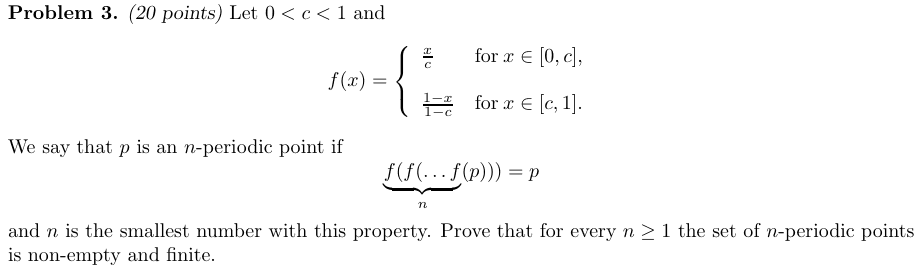
Let and
We say that is an -periodic point if
and is the smallest number with this property. Prove that for every the set of -periodic points is non-empty and finite.
Πρωτότυπο από το επίσημο PDF
Η μεταγραφή συγκρίθηκε σύμβολο προς σύμβολο με το πρωτότυπο, όχι ακόμα από άνθρωπο.
Δούλεψε τουλάχιστον 45 λεπτά πριν ανοίξεις τη λύση.
Επίσημη λύση
Solution. Let . It is easy to see that is a picewise monotone function and its graph contains linear segments; one endpoint is always on , the other is on . Thus the graph of the identity function intersects each segment once, so the number of points for which is .
Since for each -periodic points we have , the number of -periodic points is finite.
A point is -periodic if but for . But as we saw before holds only at points, so there are at most points for which for at least one . Therefore at least two of the points for which are -periodic points.
Μεταγραφή από το επίσημο κείμενο λύσεων, σελίδα 2. Η μεταγραφή δεν έχει ελεγχθεί δεύτερη φορά· αν έχεις αμφιβολία, κοίτα το πρωτότυπο.
Θέμα αρχείου: η εκφώνηση είναι το επίσημο κείμενο (μεταγραμμένο, με το πρωτότυπο παραπάνω). Η ταξινόμηση ανά αντικείμενο και η δυσκολία εκτιμήθηκαν αυτόματα· υποδείξεις και λύση στα ελληνικά προστίθενται σταδιακά.
Πώς πήγε;
Οι κινήσεις που σημειώνεις επιστρέφουν νωρίτερα στη διαλογή.