IMC 1998, Day 2, Problem 3
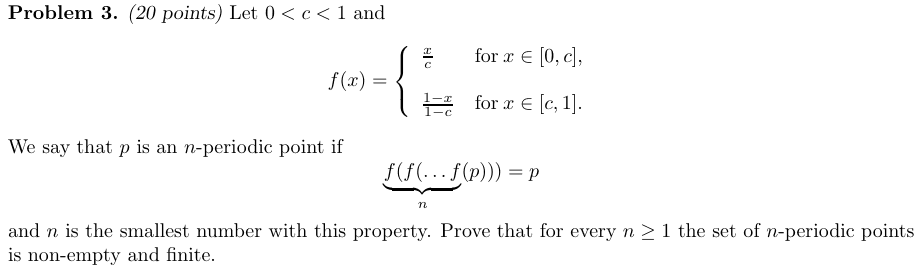
Let and
We say that is an -periodic point if
and is the smallest number with this property. Prove that for every the set of -periodic points is non-empty and finite.
Original from the official PDF
This transcription was compared symbol by symbol with the original, but not yet by a person.
Work for at least 45 minutes before opening the solution.
Official solution
Solution. Let . It is easy to see that is a picewise monotone function and its graph contains linear segments; one endpoint is always on , the other is on . Thus the graph of the identity function intersects each segment once, so the number of points for which is .
Since for each -periodic points we have , the number of -periodic points is finite.
A point is -periodic if but for . But as we saw before holds only at points, so there are at most points for which for at least one . Therefore at least two of the points for which are -periodic points.
Transcribed from the official solutions, page 2. This transcription has not been checked a second time; if in doubt, look at the original.
Archive problem: the statement is the official text (transcribed, with the original above). Subject classification and difficulty were estimated automatically; hints and a worked solution are added over time.
How did it go?
Moves you mark come back sooner in triage.