uniolympiads English

IMC 1998, Ημέρα 2, Θέμα 6

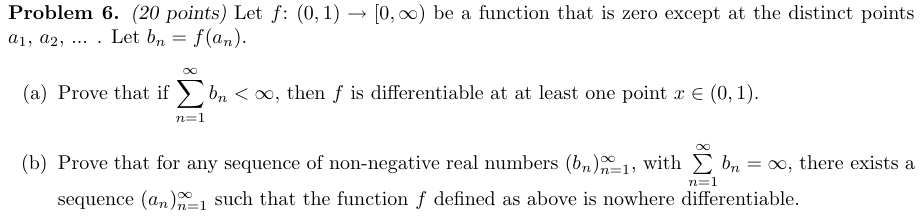
Let f ⁣:(0,1)→[0,∞)f\colon (0, 1) \to [0, \infty) be a function that is zero except at the distinct points a1,a2,…a_1, a_2, \dots. Let bn=f(an)b_n = f(a_n).

(a) Prove that if ∑n=1∞bn<∞\sum_{n=1}^{\infty} b_n < \infty, then ff is differentiable at at least one point x∈(0,1)x \in (0, 1).

(b) Prove that for any sequence of non-negative real numbers (bn)n=1∞(b_n)_{n=1}^{\infty}, with ∑n=1∞bn=∞\sum_{n=1}^{\infty} b_n = \infty, there exists a sequence (an)n=1∞(a_n)_{n=1}^{\infty} such that the function ff defined as above is nowhere differentiable.

Πρωτότυπο από το επίσημο PDF(20 points) Let f : (0, 1) → [0, ∞) be a function that is zero except at the distinct points a 1 , a 2 , ... . Let b n = f (a n ). (a) Prove that if ∞ X b n < ∞, then f is differentiable at at least one point x ∈ (0, 1). n=1 (b) Prove that for any sequence of non-negative real numbers (b n ) ∞ n=1 , with ∞ P b n = ∞, there exists a n=1 sequence (a n ) ∞ n=1 such that the function f defined as above is nowhere differentiable.

Η μεταγραφή συγκρίθηκε σύμβολο προς σύμβολο με το πρωτότυπο, όχι ακόμα από άνθρωπο.

Χρόνος σε αυτό το θέμα 0:00

Δούλεψε τουλάχιστον 45 λεπτά πριν ανοίξεις τη λύση.

Επίσημη λύση

Solution

a) We first construct a sequence cnc_n of positive numbers such that cn→∞c_n \to \infty and ∑n=1∞cnbn<12\sum\limits_{n=1}^{\infty} c_nb_n < \frac12. Let B=∑n=1∞bnB = \sum\limits_{n=1}^{\infty} b_n, and for each k=0,1,…k = 0, 1, \ldots denote by NkN_k the first positive integer for which

∑n=Nk∞bn≤B4k.\sum_{n=N_k}^{\infty} b_n \le \frac{B}{4^k}.

Now set cn=2k5Bc_n = \frac{2^k}{5B} for each nn, Nk≤n<Nk+1N_k \le n < N_{k+1}. Then we have cn→∞c_n \to \infty and

∑n=1∞cnbn=∑k=0∞∑Nk≤n<Nk+1cnbn≤∑k=0∞2k5B∑n=Nk∞bn≤∑k=0∞2k5B⋅B4k=25.\sum_{n=1}^{\infty} c_nb_n = \sum_{k=0}^{\infty} \sum_{N_k\le n<N_{k+1}} c_nb_n \le \sum_{k=0}^{\infty} \frac{2^k}{5B} \sum_{n=N_k}^{\infty} b_n \le \sum_{k=0}^{\infty} \frac{2^k}{5B} \cdot \frac{B}{4^k} = \frac25.

Consider the intervals In=(an−cnbn, an+cnbn)I_n = (a_n - c_nb_n,\ a_n + c_nb_n). The sum of their lengths is 2∑cnbn<12\sum c_nb_n < 1, thus there exists a point x0∈(0,1)x_0 \in (0, 1) which is not contained in any InI_n. We show that ff is differentiable at x0x_0, and f′(x0)=0f'(x_0) = 0. Since x0x_0 is outside of the intervals InI_n, x0≠anx_0 \ne a_n for any nn and f(x0)=0f(x_0) = 0. For arbitrary x∈(0,1)∖{x0}x \in (0, 1) \setminus \{x_0\}, if x=anx = a_n for some nn, then

∣f(x)−f(x0)x−x0∣=f(an)−0∣an−x0∣≤bncnbn=1cn,\left|\frac{f(x) - f(x_0)}{x - x_0}\right| = \frac{f(a_n) - 0}{|a_n - x_0|} \le \frac{b_n}{c_nb_n} = \frac{1}{c_n},

otherwise f(x)−f(x0)x−x0=0\frac{f(x)-f(x_0)}{x-x_0} = 0. Since cn→∞c_n \to \infty, this implies that for arbitrary ε>0\varepsilon > 0 there are only finitely many x∈(0,1)∖{x0}x \in (0, 1) \setminus \{x_0\} for which

∣f(x)−f(x0)x−x0∣<ε\left|\frac{f(x) - f(x_0)}{x - x_0}\right| < \varepsilon

does not hold, and we are done.

Remark. The variation of ff is finite, which implies that ff is differentiable almost everywhere .

b) We remove the zero elements from sequence bnb_n. Since f(x)=0f(x) = 0 except for a countable subset of (0,1)(0, 1), if ff is differentiable at some point x0x_0, then f(x0)f(x_0) and f′(x0)f'(x_0) must be 0.

It is easy to construct a sequence βn\beta_n satisfying 0<βn≤bn0 < \beta_n \le b_n, bn→0b_n \to 0 and ∑n=1∞βn=∞\sum_{n=1}^{\infty} \beta_n = \infty.

Choose the numbers a1,a2,…a_1, a_2, \ldots such that the intervals In=(an−βn, an+βn)I_n = (a_n - \beta_n,\ a_n + \beta_n) (n=1,2,…)(n = 1, 2, \ldots) cover each point of (0, 1) infinitely many times (it is possible since the sum of lengths is 2∑bn=∞2\sum b_n = \infty). Then for arbitrary x0∈(0,1)x_0 \in (0, 1), f(x0)=0f(x_0) = 0 and ε>0\varepsilon > 0 there is an nn for which βn<ε\beta_n < \varepsilon and x0∈Inx_0 \in I_n which implies

∣f(an)−f(x0)∣∣an−x0∣>bnβn≥1.\frac{|f(a_n) - f(x_0)|}{|a_n - x_0|} > \frac{b_n}{\beta_n} \ge 1.

Μεταγραφή από το επίσημο κείμενο λύσεων, σελίδες 3–4. Η μεταγραφή δεν έχει ελεγχθεί δεύτερη φορά· αν έχεις αμφιβολία, κοίτα το πρωτότυπο.

Θέμα αρχείου: η εκφώνηση είναι το επίσημο κείμενο (μεταγραμμένο, με το πρωτότυπο παραπάνω). Η ταξινόμηση ανά αντικείμενο και η δυσκολία εκτιμήθηκαν αυτόματα· υποδείξεις και λύση στα ελληνικά προστίθενται σταδιακά.

Πώς πήγε;