IMC 1998, Day 2, Problem 6
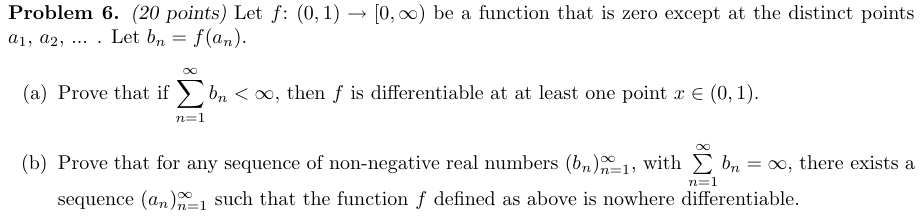
Let be a function that is zero except at the distinct points . Let .
(a) Prove that if , then is differentiable at at least one point .
(b) Prove that for any sequence of non-negative real numbers , with , there exists a sequence such that the function defined as above is nowhere differentiable.
Original from the official PDF
This transcription was compared symbol by symbol with the original, but not yet by a person.
Work for at least 45 minutes before opening the solution.
Official solution
Solution
a) We first construct a sequence of positive numbers such that and . Let , and for each denote by the first positive integer for which
Now set for each , . Then we have and
Consider the intervals . The sum of their lengths is , thus there exists a point which is not contained in any . We show that is differentiable at , and . Since is outside of the intervals , for any and . For arbitrary , if for some , then
otherwise . Since , this implies that for arbitrary there are only finitely many for which
does not hold, and we are done.
Remark. The variation of is finite, which implies that is differentiable almost everywhere .
b) We remove the zero elements from sequence . Since except for a countable subset of , if is differentiable at some point , then and must be 0.
It is easy to construct a sequence satisfying , and .
Choose the numbers such that the intervals cover each point of (0, 1) infinitely many times (it is possible since the sum of lengths is ). Then for arbitrary , and there is an for which and which implies
Transcribed from the official solutions, pages 3–4. This transcription has not been checked a second time; if in doubt, look at the original.
Archive problem: the statement is the official text (transcribed, with the original above). Subject classification and difficulty were estimated automatically; hints and a worked solution are added over time.
How did it go?
Moves you mark come back sooner in triage.