IMC 2006, Ημέρα 2, Θέμα 1
Let be a convex polygon with vertices.
(a) Prove that if is divisible by then can be triangulated (i.e. dissected into non-overlapping triangles whose vertices are vertices of ) so that each vertex of is the vertex of an odd number of triangles.
(b) Prove that if is not divisible by then can be triangulated so that there are exactly two vertices that are the vertices of an even number of the triangles.
Πρωτότυπο από το επίσημο PDF
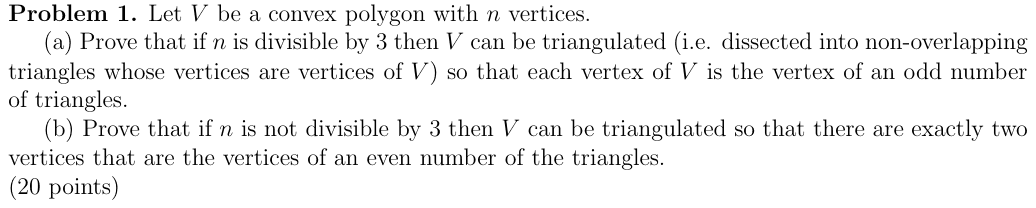
Η μεταγραφή συγκρίθηκε σύμβολο προς σύμβολο με το πρωτότυπο, όχι ακόμα από άνθρωπο.
Δούλεψε τουλάχιστον 45 λεπτά πριν ανοίξεις τη λύση.
Επίσημη λύση
Solution. Apply induction on . For the initial cases , chose the triangulations shown in the Figure to prove the statement.
[Figure in the original PDF.]
Now assume that the statement is true for some and consider the case . Denote the vertices of by . Apply the induction hypothesis on the polygon ; in this triangulation each of vertices belong to an odd number of triangles, except two vertices if is not divisible by 3. Now add triangles , and . This way we introduce two new triangles at vertices and so parity is preserved. The vertices , and share an odd number of triangles. Therefore, the number of vertices shared by even number of triangles remains the same as in polygon .
[Figure in the original PDF.]
Μεταγραφή από το επίσημο κείμενο λύσεων, σελίδα 1. Η μεταγραφή δεν έχει ελεγχθεί δεύτερη φορά· αν έχεις αμφιβολία, κοίτα το πρωτότυπο.
Θέμα αρχείου: η εκφώνηση είναι το επίσημο κείμενο (μεταγραμμένο, με το πρωτότυπο παραπάνω). Η ταξινόμηση ανά αντικείμενο και η δυσκολία εκτιμήθηκαν αυτόματα· υποδείξεις και λύση στα ελληνικά προστίθενται σταδιακά.
Πώς πήγε;
Οι κινήσεις που σημειώνεις επιστρέφουν νωρίτερα στη διαλογή.