IMC 2006, Day 2, Problem 1
Let be a convex polygon with vertices.
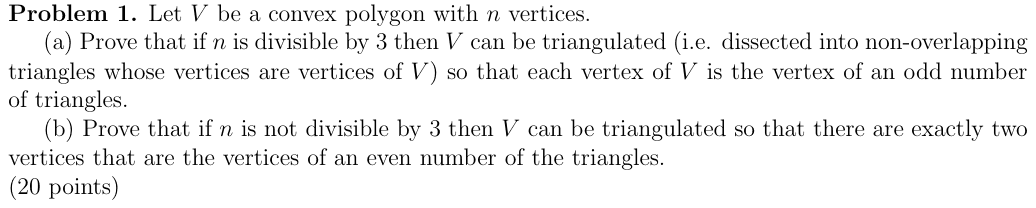
(a) Prove that if is divisible by then can be triangulated (i.e. dissected into non-overlapping triangles whose vertices are vertices of ) so that each vertex of is the vertex of an odd number of triangles.
(b) Prove that if is not divisible by then can be triangulated so that there are exactly two vertices that are the vertices of an even number of the triangles.
Original from the official PDF
This transcription was compared symbol by symbol with the original, but not yet by a person.
Work for at least 45 minutes before opening the solution.
Official solution
Solution. Apply induction on . For the initial cases , chose the triangulations shown in the Figure to prove the statement.
[Figure in the original PDF.]
Now assume that the statement is true for some and consider the case . Denote the vertices of by . Apply the induction hypothesis on the polygon ; in this triangulation each of vertices belong to an odd number of triangles, except two vertices if is not divisible by 3. Now add triangles , and . This way we introduce two new triangles at vertices and so parity is preserved. The vertices , and share an odd number of triangles. Therefore, the number of vertices shared by even number of triangles remains the same as in polygon .
[Figure in the original PDF.]
Transcribed from the official solutions, page 1. This transcription has not been checked a second time; if in doubt, look at the original.
Archive problem: the statement is the official text (transcribed, with the original above). Subject classification and difficulty were estimated automatically; hints and a worked solution are added over time.
How did it go?
Moves you mark come back sooner in triage.