uniolympiads English

IMC 2008, Ημέρα 2, Θέμα 6

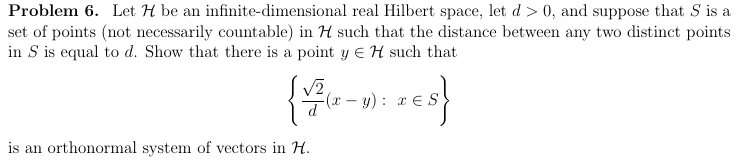
Let H\mathcal{H} be an infinite-dimensional real Hilbert space, let d>0d > 0, and suppose that SS is a set of points (not necessarily countable) in H\mathcal{H} such that the distance between any two distinct points in SS is equal to dd. Show that there is a point y∈Hy \in \mathcal{H} such that

{2d(x−y):x∈S}\left\{ \frac{\sqrt{2}}{d}(x - y) : x \in S \right\}

is an orthonormal system of vectors in H\mathcal{H}.

Πρωτότυπο από το επίσημο PDFLet H be an infinite-dimensional real Hilbert space, let d > 0, and suppose that S is a set of points (not necessarily countable) in H such that the distance between any two distinct points in S is equal to d. Show that there is a point y ∈ H such that ( √ ) 2 (x − y) : x ∈ S d is an orthonormal system of vectors in H.

Η μεταγραφή συγκρίθηκε σύμβολο προς σύμβολο με το πρωτότυπο, όχι ακόμα από άνθρωπο.

Χρόνος σε αυτό το θέμα 0:00

Δούλεψε τουλάχιστον 45 λεπτά πριν ανοίξεις τη λύση.

Επίσημη λύση

Solution. It is clear that, if B\mathcal{B} is an orthonormal system in a Hilbert space H\mathcal{H}, then {(d/2)e: e∈B}\{(d/\sqrt2)e :\ e \in \mathcal{B}\} is a set of points in H\mathcal{H}, any two of which are at distance dd apart. We need to show that every set SS of equidistant points is a translate of such a set.

We begin by noting that, if x1,x2,x3,x4∈Sx_1, x_2, x_3, x_4 \in S are four distinct points, then

⟨x2−x1,x2−x1⟩=d2,⟨x2−x1,x3−x1⟩=12(∥x2−x1∥2+∥x3−x1∥2−∥x2−x3∥2)=12d2,⟨x2−x1,x4−x3⟩=⟨x2−x1,x4−x1⟩−⟨x2−x1,x3−x1⟩=12d2−12d2=0.\begin{aligned} &\langle x_2 - x_1, x_2 - x_1\rangle = d^2, \\ &\langle x_2 - x_1, x_3 - x_1\rangle = \frac12\left(\|x_2 - x_1\|^2 + \|x_3 - x_1\|^2 - \|x_2 - x_3\|^2\right) = \frac12 d^2, \\ &\langle x_2 - x_1, x_4 - x_3\rangle = \langle x_2 - x_1, x_4 - x_1\rangle - \langle x_2 - x_1, x_3 - x_1\rangle = \frac12 d^2 - \frac12 d^2 = 0. \end{aligned}
This shows that scalar products among vectors which are finite linear combinations of the form
λ1x1+λ2x2+⋯+λnxn,\lambda_1 x_1 + \lambda_2 x_2 + \cdots + \lambda_n x_n,
where x1,x2,…,xnx_1, x_2, \ldots, x_n are distinct points in SS and λ1,λ2,…,λn\lambda_1, \lambda_2, \ldots, \lambda_n are integers with λ1+λ2+⋯+λn=0\lambda_1 + \lambda_2 + \cdots + \lambda_n = 0, are universal across all such sets SS in all Hilbert spaces H\mathcal{H}; in particular, we may conveniently evaluate them using examples of our choosing, such as the canonical example above in Rn\mathbb{R}^n. In fact this property trivially follows also when coefficients λi\lambda_i are rational, and hence by continuity any real numbers with sum 0.

If S={x1,x2,…,xn}S = \{x_1, x_2, \ldots, x_n\} is a finite set, we form

x=1n(x1+x2+⋯+xn),x = \frac1n\left(x_1 + x_2 + \cdots + x_n\right),
pick a non-zero vector z∈[Span⁡(x1−x,x2−x,…,xn−x)]⊥z \in [\operatorname{Span}(x_1 - x, x_2 - x, \ldots, x_n - x)]^\perp and seek yy in the form y=x+λzy = x + \lambda z for a suitable λ∈R\lambda \in \mathbb{R}. We find that
⟨x1−y,x2−y⟩=⟨x1−x−λz,x2−x−λz⟩=⟨x1−x,x2−x⟩+λ2∥z∥2.\langle x_1 - y, x_2 - y\rangle = \langle x_1 - x - \lambda z, x_2 - x - \lambda z\rangle = \langle x_1 - x, x_2 - x\rangle + \lambda^2\|z\|^2.
⟨x1−x,x2−x⟩\langle x_1 - x, x_2 - x\rangle may be computed by our remark above as
⟨x1−x,x2−x⟩=d22⟨(1n−1,1n,1n,…,1n)⊤,(1n,1n−1,1n,…,1n)⊤⟩Rn=d22 (2n(1n−1)+n−2n2)=−d22n.\begin{aligned} \langle x_1 - x, x_2 - x\rangle &= \frac{d^2}{2}\left\langle\left(\frac1n - 1, \frac1n, \frac1n, \ldots, \frac1n\right)^\top, \left(\frac1n, \frac1n - 1, \frac1n, \ldots, \frac1n\right)^\top\right\rangle_{\mathbb{R}^n} \\ &= \frac{d^2}{2}\ \left(\frac2n\left(\frac1n - 1\right) + \frac{n-2}{n^2}\right) = -\frac{d^2}{2n}. \end{aligned}
So the choice λ=d2n∥z∥\lambda = \dfrac{d}{\sqrt{2n}\|z\|} will make all vectors 2d(xi−y)\dfrac{\sqrt2}{d}(x_i - y) orthogonal to each other; it is easily checked as above that they will also be of length one.

Let now SS be an infinite set. Pick an infinite sequence T={x1,x2,…,xn,…}T = \{x_1, x_2, \ldots, x_n, \ldots\} of distinct points in SS. We claim that the sequence

yn=1n(x1+x2+⋯+xn)y_n = \frac1n(x_1 + x_2 + \cdots + x_n)
is a Cauchy sequence in H\mathcal{H}. (This is the crucial observation.) Indeed, for m>nm > n, the norm ∥ym−yn∥\|y_m - y_n\| may be computed by the above remark as
∥ym−yn∥2=d22∥(1m−1n,…,1m−1n,1m,…,1m)⊤∥Rm2=d22(n(m−n)2m2n2+m−nm2)=d22(m−n)(m−n+n)m2n=d22m−nmn=d22(1n−1m)→0,m,n→∞.\begin{aligned} \|y_m - y_n\|^2 &= \frac{d^2}{2}\left\|\left(\frac1m - \frac1n, \ldots, \frac1m - \frac1n, \frac1m, \ldots, \frac1m\right)^\top\right\|^2_{\mathbb{R}^m} = \frac{d^2}{2}\left(\frac{n(m-n)^2}{m^2n^2} + \frac{m-n}{m^2}\right) \\ &= \frac{d^2}{2}\frac{(m-n)(m-n+n)}{m^2n} = \frac{d^2}{2}\frac{m-n}{mn} = \frac{d^2}{2}\left(\frac1n - \frac1m\right) \to 0, \quad m, n \to \infty. \end{aligned}
By completeness of H\mathcal{H}, it follows that there exists a limit
y=lim⁡n→∞yn∈H.y = \lim_{n\to\infty} y_n \in \mathcal{H}.
We claim that yy sastisfies all conditions of the problem. For m>n>pm > n > p, with nn, pp fixed, we compute
∥xn−ym∥2=d22∥(−1m,…,−1m,1−1m,−1m,…,−1m)⊤∥Rm2=d22[m−1m2+(m−1)2m2]=d22m−1m→d22,m→∞,\begin{aligned} \|x_n - y_m\|^2 &= \frac{d^2}{2}\left\|\left(-\frac1m, \ldots, -\frac1m, 1 - \frac1m, -\frac1m, \ldots, -\frac1m\right)^\top\right\|^2_{\mathbb{R}^m} \\ &= \frac{d^2}{2}\left[\frac{m-1}{m^2} + \frac{(m-1)^2}{m^2}\right] = \frac{d^2}{2}\frac{m-1}{m} \to \frac{d^2}{2}, \quad m \to \infty, \end{aligned}
showing that ∥xn−y∥=d/2\|x_n - y\| = d/\sqrt2, as well as
⟨xn−ym,xp−ym⟩=d22⟨(−1m,…,−1m,…,1−1m,…,−1m)⊤,(−1m,…,1−1m,…,−1m,…,−1m)⊤⟩Rm=d22[m−2m2−2m(1−1m)]=−d22m→0,m→∞,\begin{aligned} \langle x_n - y_m, x_p - y_m\rangle &= \frac{d^2}{2}\Bigg\langle\left(-\frac1m, \ldots, -\frac1m, \ldots, 1 - \frac1m, \ldots, -\frac1m\right)^\top, \\ &\qquad\qquad \left(-\frac1m, \ldots, 1 - \frac1m, \ldots, -\frac1m, \ldots, -\frac1m\right)^\top\Bigg\rangle_{\mathbb{R}^m} \\ &= \frac{d^2}{2}\left[\frac{m-2}{m^2} - \frac2m\left(1 - \frac1m\right)\right] = -\frac{d^2}{2m} \to 0, \quad m \to \infty, \end{aligned}
showing that ⟨xn−y,xp−y⟩=0\langle x_n - y, x_p - y\rangle = 0, so that
{2d(xn−y): n∈N}\left\{\frac{\sqrt2}{d}(x_n - y) :\ n \in \mathbb{N}\right\}
is indeed an orthonormal system of vectors.

This completes the proof in the case when T=ST = S, which we can always take if SS is countable. If it is not, let x′,x′′x', x'' be any two distinct points in S∖TS\setminus T. Then applying the above procedure to the set

T′={x′,x′′,x1,x2,…,xn,…}T' = \{x', x'', x_1, x_2, \ldots, x_n, \ldots\}
it follows that
lim⁡n→∞x′+x′′+x1+x2+⋯+xnn+2=lim⁡n→∞x1+x2+⋯+xnn=y\lim_{n\to\infty}\frac{x' + x'' + x_1 + x_2 + \cdots + x_n}{n+2} = \lim_{n\to\infty}\frac{x_1 + x_2 + \cdots + x_n}{n} = y
satisfies that
{2d(x′−y),2d(x′′−y)}∪{2d(xn−y): n∈N}\left\{\frac{\sqrt2}{d}(x' - y), \frac{\sqrt2}{d}(x'' - y)\right\} \cup \left\{\frac{\sqrt2}{d}(x_n - y) :\ n \in \mathbb{N}\right\}
is still an orthonormal system.

This it true for any distinct x′,x′′∈S∖Tx', x'' \in S\setminus T; it follows that the entire system

{2d(x−y): x∈S}\left\{\frac{\sqrt2}{d}(x - y) :\ x \in S\right\}
is an orthonormal system of vectors in H\mathcal{H}, as required.

Μεταγραφή από το επίσημο κείμενο λύσεων, σελίδα 3. Η μεταγραφή δεν έχει ελεγχθεί δεύτερη φορά· αν έχεις αμφιβολία, κοίτα το πρωτότυπο.

Θέμα αρχείου: η εκφώνηση είναι το επίσημο κείμενο (μεταγραμμένο, με το πρωτότυπο παραπάνω). Η ταξινόμηση ανά αντικείμενο και η δυσκολία εκτιμήθηκαν αυτόματα· υποδείξεις και λύση στα ελληνικά προστίθενται σταδιακά.

Πώς πήγε;