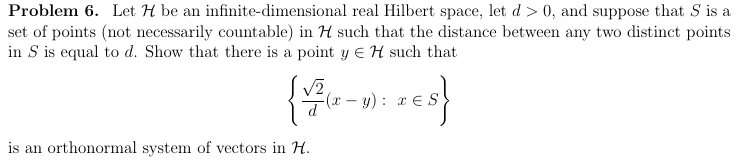
Let H be an infinite-dimensional real Hilbert space, let d>0, and suppose that S is a set of points (not necessarily countable) in H such that the distance between any two distinct points in S is equal to d. Show that there is a point y∈H such that
{d2(x−y):x∈S}
is an orthonormal system of vectors in H.
Original from the official PDF
This transcription was compared symbol by symbol with the original, but not yet by a person.
Time on this problem
Work for at least 45 minutes before opening the solution.
Official solution
Solution. It is clear that, if B is an orthonormal system in a Hilbert space H, then {(d/2)e:e∈B} is a set of points in H, any two of which are at distance d apart. We need to show that every set S of equidistant points is a translate of such a set.
We begin by noting that, if x1,x2,x3,x4∈S are four distinct points, then
This shows that scalar products among vectors which are finite linear combinations of the form
λ1x1+λ2x2+⋯+λnxn,
where x1,x2,…,xn are distinct points in S and λ1,λ2,…,λn are integers with λ1+λ2+⋯+λn=0, are universal across all such sets S in all Hilbert spaces H; in particular, we may conveniently evaluate them using examples of our choosing, such as the canonical example above in Rn. In fact this property trivially follows also when coefficients λi are rational, and hence by continuity any real numbers with sum 0.
If S={x1,x2,…,xn} is a finite set, we form
x=n1(x1+x2+⋯+xn),
pick a non-zero vector z∈[Span(x1−x,x2−x,…,xn−x)]⊥ and seek y in the form y=x+λz for a suitable λ∈R. We find that
So the choice λ=2n∥z∥d will make all vectors d2(xi−y) orthogonal to each other; it is easily checked as above that they will also be of length one.
Let now S be an infinite set. Pick an infinite sequence T={x1,x2,…,xn,…} of distinct points in S. We claim that the sequence
yn=n1(x1+x2+⋯+xn)
is a Cauchy sequence in H. (This is the crucial observation.) Indeed, for m>n, the norm ∥ym−yn∥ may be computed by the above remark as
This completes the proof in the case when T=S, which we can always take if S is countable. If it is not, let x′,x′′ be any two distinct points in S∖T. Then applying the above procedure to the set
This it true for any distinct x′,x′′∈S∖T; it follows that the entire system
{d2(x−y):x∈S}
is an orthonormal system of vectors in H, as required.
Transcribed from the official solutions, page 3. This transcription has not been checked a second time; if in doubt, look at the original.
Archive problem: the statement is the official text (transcribed, with the original above). Subject classification and difficulty were estimated automatically; hints and a worked solution are added over time.