IMC 2012, Ημέρα 1, Θέμα 3
Given an integer , let be the group of permutations of the numbers . Two players, A and B, play the following game. Taking turns, they select elements (one element at a time) from the group . It is forbidden to select an element that has already been selected. The game ends when the selected elements generate the whole group . The player who made the last move loses the game. The first move is made by A. Which player has a winning strategy?
Πρωτότυπο από το επίσημο PDF
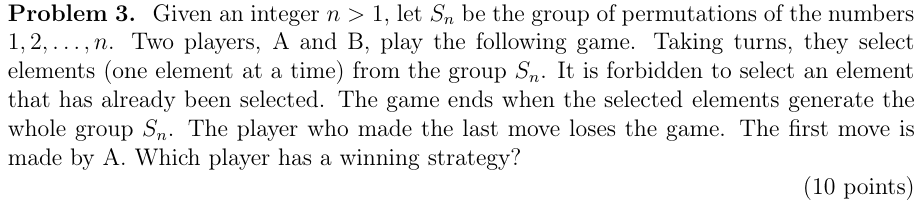
Η μεταγραφή συγκρίθηκε σύμβολο προς σύμβολο με το πρωτότυπο, όχι ακόμα από άνθρωπο.
Δούλεψε τουλάχιστον 45 λεπτά πριν ανοίξεις τη λύση.
Επίσημη λύση
(Proposed by Fedor Petrov, St. Petersburg State University)
Solution. Player A can win for (by selecting the identity) and for (selecting a 3-cycle).
We prove that B has a winning strategy for . Consider the moment when all permitted moves lose immediately, and let be the subgroup generated by the elements selected by the players. Choosing another element from would not lose immediately, so all elements of must have been selected. Since and any other element generate , must be a maximal subgroup in .
If is even, then the next player is A, so B wins. Denote by the order of the subgroup generated by the first selected elements; then . We show that B can achieve that is even and ; then will be even and A will be forced to make the final – losing – move.
Denote by the element chosen by A on his first move. If the order of is even, then B may choose the identical permutation and he will have even and .
If is odd, then is a product of disjoint odd cycles, so it is an even permutation. Then B can chose the permutation which is another even permutation. Since and are elements of the alternating group , they cannot generate the whole . Since the order of is 2, B achieves .
Remark. If , all subgrups of odd order are subgroups of which has even order. Hence, all maximal subgroups have even order and B is never forced to lose.
Μεταγραφή από το επίσημο κείμενο λύσεων, σελίδα 2. Η μεταγραφή δεν έχει ελεγχθεί δεύτερη φορά· αν έχεις αμφιβολία, κοίτα το πρωτότυπο.
Θέμα αρχείου: η εκφώνηση είναι το επίσημο κείμενο (μεταγραμμένο, με το πρωτότυπο παραπάνω). Η ταξινόμηση ανά αντικείμενο και η δυσκολία εκτιμήθηκαν αυτόματα· υποδείξεις και λύση στα ελληνικά προστίθενται σταδιακά.
Πώς πήγε;
Οι κινήσεις που σημειώνεις επιστρέφουν νωρίτερα στη διαλογή.