IMC 2012, Day 1, Problem 3
Given an integer , let be the group of permutations of the numbers . Two players, A and B, play the following game. Taking turns, they select elements (one element at a time) from the group . It is forbidden to select an element that has already been selected. The game ends when the selected elements generate the whole group . The player who made the last move loses the game. The first move is made by A. Which player has a winning strategy?
Original from the official PDF
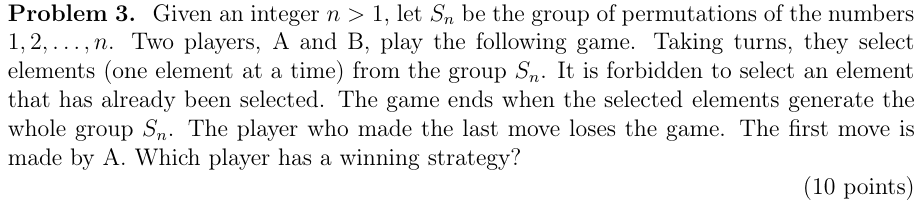
This transcription was compared symbol by symbol with the original, but not yet by a person.
Work for at least 45 minutes before opening the solution.
Official solution
(Proposed by Fedor Petrov, St. Petersburg State University)
Solution. Player A can win for (by selecting the identity) and for (selecting a 3-cycle).
We prove that B has a winning strategy for . Consider the moment when all permitted moves lose immediately, and let be the subgroup generated by the elements selected by the players. Choosing another element from would not lose immediately, so all elements of must have been selected. Since and any other element generate , must be a maximal subgroup in .
If is even, then the next player is A, so B wins. Denote by the order of the subgroup generated by the first selected elements; then . We show that B can achieve that is even and ; then will be even and A will be forced to make the final – losing – move.
Denote by the element chosen by A on his first move. If the order of is even, then B may choose the identical permutation and he will have even and .
If is odd, then is a product of disjoint odd cycles, so it is an even permutation. Then B can chose the permutation which is another even permutation. Since and are elements of the alternating group , they cannot generate the whole . Since the order of is 2, B achieves .
Remark. If , all subgrups of odd order are subgroups of which has even order. Hence, all maximal subgroups have even order and B is never forced to lose.
Transcribed from the official solutions, page 2. This transcription has not been checked a second time; if in doubt, look at the original.
Archive problem: the statement is the official text (transcribed, with the original above). Subject classification and difficulty were estimated automatically; hints and a worked solution are added over time.
How did it go?
Moves you mark come back sooner in triage.