IMC 2012, Ημέρα 2, Θέμα 1
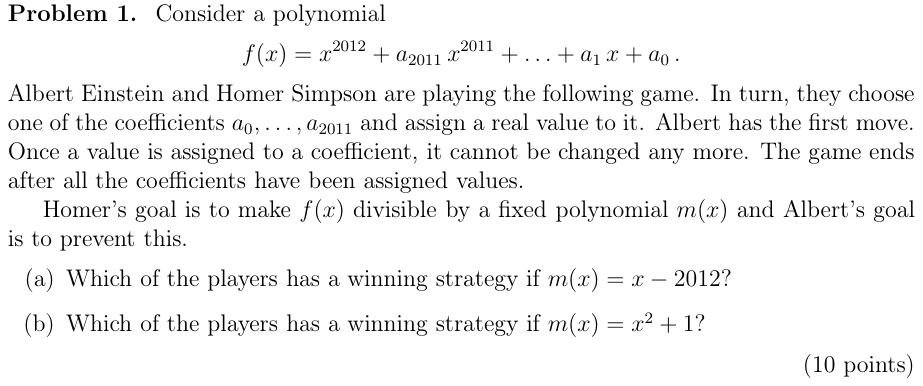
Consider a polynomial
Albert Einstein and Homer Simpson are playing the following game. In turn, they choose one of the coefficients and assign a real value to it. Albert has the first move. Once a value is assigned to a coefficient, it cannot be changed any more. The game ends after all the coefficients have been assigned values.
Homer's goal is to make divisible by a fixed polynomial and Albert's goal is to prevent this.
(a) Which of the players has a winning strategy if ?
(b) Which of the players has a winning strategy if ?
Πρωτότυπο από το επίσημο PDF
Η μεταγραφή συγκρίθηκε σύμβολο προς σύμβολο με το πρωτότυπο, όχι ακόμα από άνθρωπο.
Δούλεψε τουλάχιστον 45 λεπτά πριν ανοίξεις τη λύση.
Επίσημη λύση
(Proposed by Fedor Duzhin, Nanyang Technological University)
Solution. We show that Homer has a winning strategy in both part (a) and part (b).
(a) Notice that the last move is Homer's, and only the last move matters. Homer wins if and only if , i.e.
(b) Define the polynomials
Notice that both and have an even number of undetermined coefficients in the beginning of the game. A possible strategy for Homer is to follow Albert: whenever Albert assigns a value to a coefficient in or , in the next move Homer chooses the value for a coefficient in the same polynomial. This way Homer defines the last coefficient in and he also chooses the last coefficient in . Similarly to part (a), Homer can choose these two last coefficients in such a way that both and hold.
Μεταγραφή από το επίσημο κείμενο λύσεων, σελίδα 1. Η μεταγραφή δεν έχει ελεγχθεί δεύτερη φορά· αν έχεις αμφιβολία, κοίτα το πρωτότυπο.
Θέμα αρχείου: η εκφώνηση είναι το επίσημο κείμενο (μεταγραμμένο, με το πρωτότυπο παραπάνω). Η ταξινόμηση ανά αντικείμενο και η δυσκολία εκτιμήθηκαν αυτόματα· υποδείξεις και λύση στα ελληνικά προστίθενται σταδιακά.
Πώς πήγε;
Οι κινήσεις που σημειώνεις επιστρέφουν νωρίτερα στη διαλογή.