IMC 2012, Day 2, Problem 1
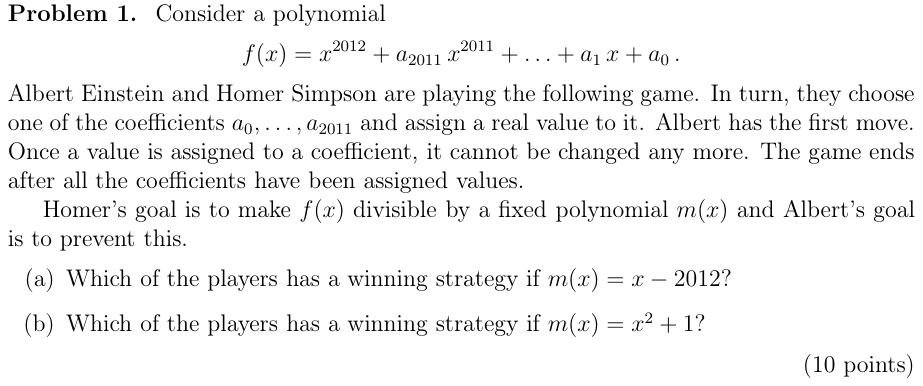
Consider a polynomial
Albert Einstein and Homer Simpson are playing the following game. In turn, they choose one of the coefficients and assign a real value to it. Albert has the first move. Once a value is assigned to a coefficient, it cannot be changed any more. The game ends after all the coefficients have been assigned values.
Homer's goal is to make divisible by a fixed polynomial and Albert's goal is to prevent this.
(a) Which of the players has a winning strategy if ?
(b) Which of the players has a winning strategy if ?
Original from the official PDF
This transcription was compared symbol by symbol with the original, but not yet by a person.
Work for at least 45 minutes before opening the solution.
Official solution
(Proposed by Fedor Duzhin, Nanyang Technological University)
Solution. We show that Homer has a winning strategy in both part (a) and part (b).
(a) Notice that the last move is Homer's, and only the last move matters. Homer wins if and only if , i.e.
(b) Define the polynomials
Notice that both and have an even number of undetermined coefficients in the beginning of the game. A possible strategy for Homer is to follow Albert: whenever Albert assigns a value to a coefficient in or , in the next move Homer chooses the value for a coefficient in the same polynomial. This way Homer defines the last coefficient in and he also chooses the last coefficient in . Similarly to part (a), Homer can choose these two last coefficients in such a way that both and hold.
Transcribed from the official solutions, page 1. This transcription has not been checked a second time; if in doubt, look at the original.
Archive problem: the statement is the official text (transcribed, with the original above). Subject classification and difficulty were estimated automatically; hints and a worked solution are added over time.
How did it go?
Moves you mark come back sooner in triage.