IMC 2013, Ημέρα 1, Θέμα 3
There are students in a school (, ). Each week students go on a trip. After several trips the following condition was fulfilled: every two students were together on at least one trip. What is the minimum number of trips needed for this to happen?
Πρωτότυπο από το επίσημο PDF
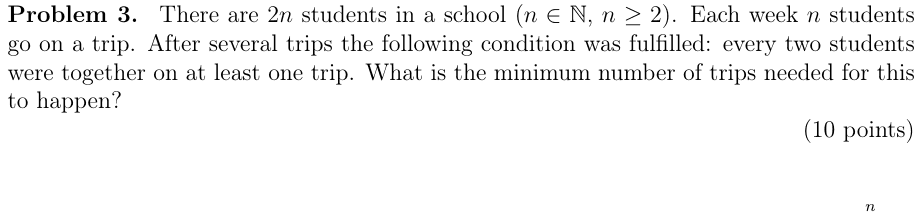
Η μεταγραφή συγκρίθηκε σύμβολο προς σύμβολο με το πρωτότυπο, όχι ακόμα από άνθρωπο.
Δούλεψε τουλάχιστον 45 λεπτά πριν ανοίξεις τη λύση.
Επίσημη λύση
(Proposed by Oleksandr Rybak, Kiev, Ukraine)
Solution. We prove that for any the answer is .
First we show that less than 6 trips is not sufficient. In that case the total quantity of students in all trips would not exceed . A student meets other students in each trip, so he or she takes part on at least 3 excursions to meet all of his or her schoolmates. Hence the total quantity of students during the trips is not less then which is impossible.
Now let's build an example for 6 trips.
If is even, we may divide students into equal groups , , , . Then we may organize the trips with groups , , , , and , respectively.
If is odd and divisible by 3, we may divide all students into equal groups , , , , , . Then the members of trips may be the following: , , , , , .
In the remaining cases let be, where and are natural numbers. Let's form the groups , , , of students each, and , , , , , of students each. Then we apply the previous cases and organize the following trips: , , , , , .
Μεταγραφή από το επίσημο κείμενο λύσεων, σελίδες 1–2. Η μεταγραφή δεν έχει ελεγχθεί δεύτερη φορά· αν έχεις αμφιβολία, κοίτα το πρωτότυπο.
Θέμα αρχείου: η εκφώνηση είναι το επίσημο κείμενο (μεταγραμμένο, με το πρωτότυπο παραπάνω). Η ταξινόμηση ανά αντικείμενο και η δυσκολία εκτιμήθηκαν αυτόματα· υποδείξεις και λύση στα ελληνικά προστίθενται σταδιακά.
Πώς πήγε;
Οι κινήσεις που σημειώνεις επιστρέφουν νωρίτερα στη διαλογή.