IMC 2013, Day 1, Problem 3
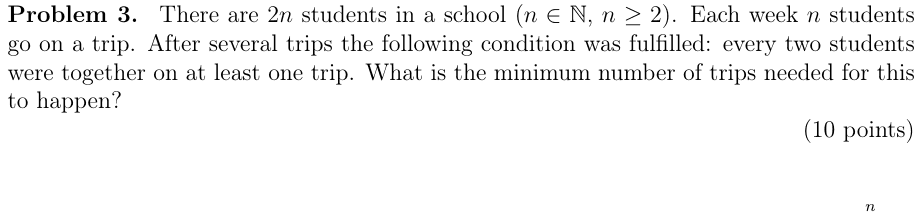
There are students in a school (, ). Each week students go on a trip. After several trips the following condition was fulfilled: every two students were together on at least one trip. What is the minimum number of trips needed for this to happen?
Original from the official PDF
This transcription was compared symbol by symbol with the original, but not yet by a person.
Work for at least 45 minutes before opening the solution.
Official solution
(Proposed by Oleksandr Rybak, Kiev, Ukraine)
Solution. We prove that for any the answer is .
First we show that less than 6 trips is not sufficient. In that case the total quantity of students in all trips would not exceed . A student meets other students in each trip, so he or she takes part on at least 3 excursions to meet all of his or her schoolmates. Hence the total quantity of students during the trips is not less then which is impossible.
Now let's build an example for 6 trips.
If is even, we may divide students into equal groups , , , . Then we may organize the trips with groups , , , , and , respectively.
If is odd and divisible by 3, we may divide all students into equal groups , , , , , . Then the members of trips may be the following: , , , , , .
In the remaining cases let be, where and are natural numbers. Let's form the groups , , , of students each, and , , , , , of students each. Then we apply the previous cases and organize the following trips: , , , , , .
Transcribed from the official solutions, pages 1–2. This transcription has not been checked a second time; if in doubt, look at the original.
Archive problem: the statement is the official text (transcribed, with the original above). Subject classification and difficulty were estimated automatically; hints and a worked solution are added over time.
How did it go?
Moves you mark come back sooner in triage.