uniolympiads English

IMC 2014, Ημέρα 1, Θέμα 2

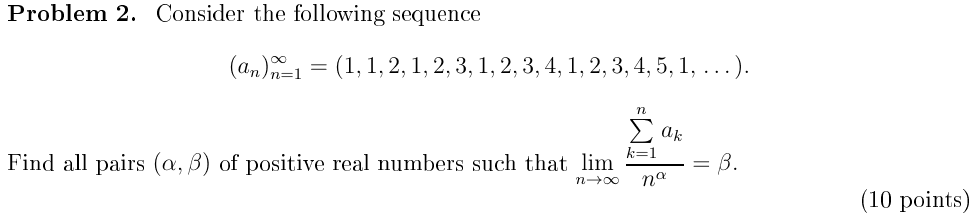
Consider the following sequence

(an)n=1∞=(1,1,2,1,2,3,1,2,3,4,1,2,3,4,5,1,… ).(a_n)_{n=1}^{\infty} = (1, 1, 2, 1, 2, 3, 1, 2, 3, 4, 1, 2, 3, 4, 5, 1, \dots).

Find all pairs (α,β)(\alpha, \beta) of positive real numbers such that lim⁡n→∞∑k=1naknα=β\lim_{n \to \infty} \frac{\sum_{k=1}^{n} a_k}{n^\alpha} = \beta.

Πρωτότυπο από το επίσημο PDFConsider the following sequen e (a n ) ∞ n=1 = (1, 1, 2, 1, 2, 3, 1, 2, 3, 4, 1, 2, 3, 4, 5, 1, . . . ). n P a k k=1 Find all pairs (α, β) of positive real numbers su h that lim n→∞ n α = β.

Η μεταγραφή συγκρίθηκε σύμβολο προς σύμβολο με το πρωτότυπο, όχι ακόμα από άνθρωπο.

Χρόνος σε αυτό το θέμα 0:00

Δούλεψε τουλάχιστον 45 λεπτά πριν ανοίξεις τη λύση.

Επίσημη λύση

(Proposed by Tomas Barta, Charles University, Prague)

Solution. Let Nn=(n+12)N_n = \binom{n+1}{2} (then aNna_{N_n} is the first appearance of number nn in the sequence) and consider limit of the subsequence

bNn:=∑k=1NnakNnα=∑k=1n1+⋯+k(n+12)α=∑k=1n(k+12)(n+12)α=(n+23)(n+12)α=16n3(1+2/n)(1+1/n)(1/2)αn2α(1+1/n)α.b_{N_n} := \frac{\sum_{k=1}^{N_n} a_k}{N_n^\alpha} = \frac{\sum_{k=1}^{n} 1+\cdots+k}{\binom{n+1}{2}^\alpha} = \frac{\sum_{k=1}^{n}\binom{k+1}{2}}{\binom{n+1}{2}^\alpha} = \frac{\binom{n+2}{3}}{\binom{n+1}{2}^\alpha} = \frac{\frac16 n^3(1+2/n)(1+1/n)}{(1/2)^\alpha n^{2\alpha}(1+1/n)^\alpha}.
We can see that lim⁡n→∞bNn\lim\limits_{n\to\infty} b_{N_n} is positive and finite if and only if α=3/2\alpha = 3/2. In this case the limit is equal to β=23\beta = \frac{\sqrt2}{3}. So, this pair (α,β)=(32,23)(\alpha,\beta) = (\frac32, \frac{\sqrt2}{3}) is the only candidate for solution. We will show convergence of the original sequence for these values of α\alpha and β\beta.

Let NN be a positive integer in [Nn+1,Nn+1][N_n+1, N_{n+1}], i.e., N=Nn+mN = N_n+m for some 1≤m≤n+11\le m\le n+1. Then we have

bN=(n+23)+(m+12)((n+12)+m)3/2b_N = \frac{\binom{n+2}{3} + \binom{m+1}{2}}{\left(\binom{n+1}{2} + m\right)^{3/2}}
which can be estimated by
(n+23)((n+12)+n)3/2≤bN≤(n+23)+(n+12)(n+12)3/2.\frac{\binom{n+2}{3}}{\left(\binom{n+1}{2} + n\right)^{3/2}} \le b_N \le \frac{\binom{n+2}{3} + \binom{n+1}{2}}{\binom{n+1}{2}^{3/2}}.
Since both bounds converge to 23\frac{\sqrt2}{3}, the sequence bNb_N has the same limit and we are done.

Μεταγραφή από το επίσημο κείμενο λύσεων, σελίδα 2. Η μεταγραφή δεν έχει ελεγχθεί δεύτερη φορά· αν έχεις αμφιβολία, κοίτα το πρωτότυπο.

Θέμα αρχείου: η εκφώνηση είναι το επίσημο κείμενο (μεταγραμμένο, με το πρωτότυπο παραπάνω). Η ταξινόμηση ανά αντικείμενο και η δυσκολία εκτιμήθηκαν αυτόματα· υποδείξεις και λύση στα ελληνικά προστίθενται σταδιακά.

Πώς πήγε;