(Proposed by Stephan Neupert, TUM, München)
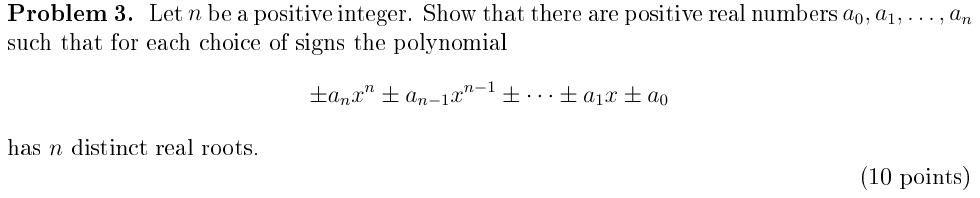
Solution. We proceed by induction on n. The statement is trivial for n=1. Thus assume that we have some an,…,a0 which satisfy the conditions for some n. Consider now the polynomials
P~(x)=±anxn+1±an−1xn±…±a1x2±a0x
By induction hypothesis and
a0=0, each of these polynomials has
n+1 distinct zeros, including the
n nonzero roots of
±anxn±an−1xn−1±…±a1x±a0 and
0. In particular none of the polynomials has a root which is a local extremum. Hence we can choose some
ε>0 such that for each such polynomial
P~(x) and each of its local extrema
s we have
∣P~(s)∣>ε. We claim that then each of the polynomials
P(x)=±anxn+1±an−1xn±…±a1x2±a0x±ε
has exactly
n+1 distinct zeros as well. As
P~(x) has
n+1 distinct zeros, it admits a local extremum at
n points. Call these local extrema
−∞=s0<s1<s2<…<sn<sn+1=∞. Then for each
i∈{0,1,…,n} the values
P~(si) and
P~(si+1) have opposite signs (with the obvious convention at infinity). By choice of
ε the same holds true for
P(si) and
P(si+1). Hence there is at least one real zero of
P(x) in each interval
(si,si+1), i.e.
P(x) has at least (and therefore exactly)
n+1 zeros. This shows that we have found a set of positive reals
an+1′=an, an′=an−1,…,a1′=a0, a0′=ε with the desired properties.
Μεταγραφή από το επίσημο κείμενο λύσεων, σελίδες 2–3. Η μεταγραφή δεν έχει ελεγχθεί δεύτερη φορά· αν έχεις αμφιβολία, κοίτα το πρωτότυπο.