IMC 2019, Ημέρα 1, Θέμα 5
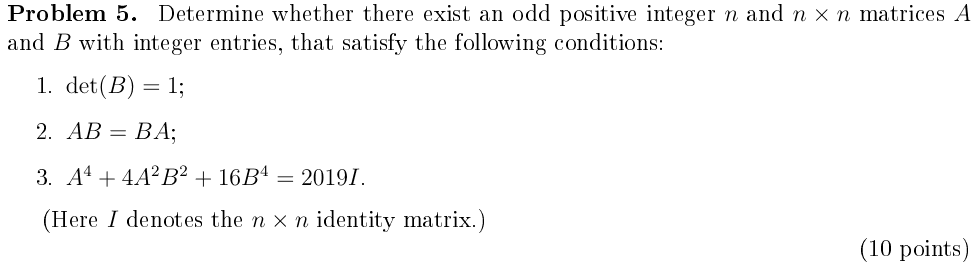
Determine whether there exist an odd positive integer and matrices and with integer entries, that satisfy the following conditions:
- ;
- ;
- .
(Here denotes the identity matrix.)
Πρωτότυπο από το επίσημο PDF
Η μεταγραφή συγκρίθηκε σύμβολο προς σύμβολο με το πρωτότυπο, όχι ακόμα από άνθρωπο.
Δούλεψε τουλάχιστον 45 λεπτά πριν ανοίξεις τη λύση.
Επίσημη λύση
Proposed by Orif Ibrogimov, ETH Zurich and National University of Uzbekistan
Hint: Consider the determinants modulo 4.
Remark. The proposed solution was more complicated and involved; during the contest it turned out that a signficantly simplified solution exists – which we now provide below.
Solution 1. We show that there are no such matrices.
Notice that can factorized as
Let and be the two factors above. Then
The matrices have integer entries, so their determinants are integers. Moreover, from we can see that
This implies that , but this is a contradiction because is a quadratic nonresidue modulo 4.
Solution 2. Notice that
Μεταγραφή από το επίσημο κείμενο λύσεων, σελίδες 4–5. Η μεταγραφή δεν έχει ελεγχθεί δεύτερη φορά· αν έχεις αμφιβολία, κοίτα το πρωτότυπο.
Θέμα αρχείου: η εκφώνηση είναι το επίσημο κείμενο (μεταγραμμένο, με το πρωτότυπο παραπάνω). Η ταξινόμηση ανά αντικείμενο και η δυσκολία εκτιμήθηκαν αυτόματα· υποδείξεις και λύση στα ελληνικά προστίθενται σταδιακά.
Πώς πήγε;
Οι κινήσεις που σημειώνεις επιστρέφουν νωρίτερα στη διαλογή.