IMC 2019, Day 1, Problem 5
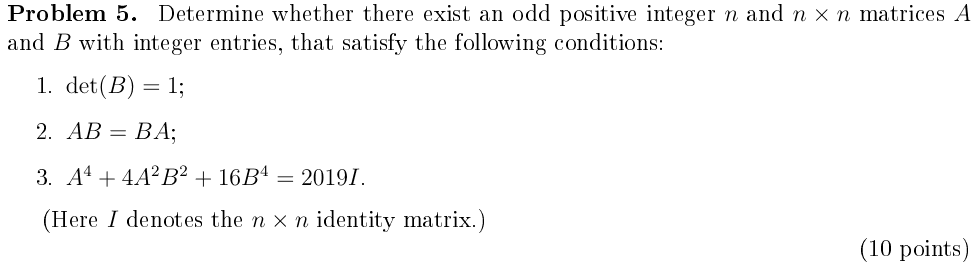
Determine whether there exist an odd positive integer and matrices and with integer entries, that satisfy the following conditions:
- ;
- ;
- .
(Here denotes the identity matrix.)
Original from the official PDF
This transcription was compared symbol by symbol with the original, but not yet by a person.
Work for at least 45 minutes before opening the solution.
Official solution
Proposed by Orif Ibrogimov, ETH Zurich and National University of Uzbekistan
Hint: Consider the determinants modulo 4.
Remark. The proposed solution was more complicated and involved; during the contest it turned out that a signficantly simplified solution exists – which we now provide below.
Solution 1. We show that there are no such matrices.
Notice that can factorized as
Let and be the two factors above. Then
The matrices have integer entries, so their determinants are integers. Moreover, from we can see that
This implies that , but this is a contradiction because is a quadratic nonresidue modulo 4.
Solution 2. Notice that
Transcribed from the official solutions, pages 4–5. This transcription has not been checked a second time; if in doubt, look at the original.
Archive problem: the statement is the official text (transcribed, with the original above). Subject classification and difficulty were estimated automatically; hints and a worked solution are added over time.
How did it go?
Moves you mark come back sooner in triage.