IMC 2021, Ημέρα 1, Θέμα 4
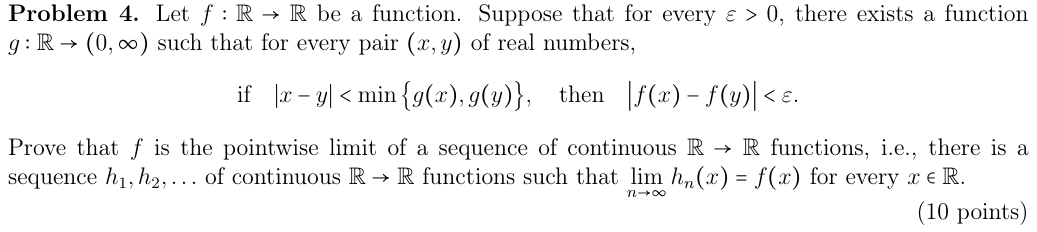
Let be a function. Suppose that for every , there exists a function such that for every pair of real numbers,
Prove that is the pointwise limit of a sequence of continuous functions, i.e., there is a sequence of continuous functions such that for every .
Πρωτότυπο από το επίσημο PDF
Η μεταγραφή συγκρίθηκε σύμβολο προς σύμβολο με το πρωτότυπο, όχι ακόμα από άνθρωπο.
Δούλεψε τουλάχιστον 45 λεπτά πριν ανοίξεις τη λύση.
Επίσημη λύση
(proposed by Camille Mau, Nanyang Technological University, Singapore)
Hint: Start from a segment in place of and use its compactness. Or recall the cool things called “the Lebesgue characterization theorem” and “the Baire characterization theorem”.
Solution 1. Since depends also on , let us use the notation . Considering only for positive integer will suffice to reach our conclusions, hence we may use in place of and thus assume decreasing in .
For any , choose . Of the -neighborhoods of all select (using local compactness of the reals) an inclusion-minimal locally finite covering . From its inclusion-minimality it follows that we may enumerate with so that only when and the enumeration goes from left to right on the real line. For an assumed , let be the center of and , so that and for all .
Now define a continuous so that it equals in , and so that changes continuously between and in the intersection .
Now we show that pointwise. Fix a point and , and choose
- belongs to the unique . Then using the monotonicity of in we have
Hence
- belongs to . Similar to the previous case,
Since is between and by construction, we have
We have that holds for sufficiently large , which proves the pointwise convergence.
Solution 2. This solution uses the Baire characterization theorem: A function is a pointwise limit of continuous functions if and only if its restriction to every non-empty closed subset of has a point of continuity.
Assume the contrary in view of the above theorem: is a non-empty closed set and has no point of continuity in . Let’s think that is defined only on .
Then for all there exist rationals for which , . Apply the Baire category theorem: If a complete metric space is a countable union of sets then some of the sets is dense in a positive radius metric ball of . It follows that there exist and , which serve for a subset which is dense on a certain ball (in the induced metric of the real line) . It yields that both sets and are dense in .
Choose and find for which the set is also dense on a certain ball . Partition into subsets where and , one of them is again dense somewhere in , say the latter.
Now take any point and a very close (within distance ) to point with but . This pair contradicts the property of from the problem statement.
Solution 3. This solution uses the Lebesgue characterization theorem: If is a function and, for all real , the sublevel and superlevel sets , are countable intersections of open sets then is a pointwise limit of continuous functions.
Now the solution follows from the formula with a countable intersection of the unions of intervals:
The left hand side is obviously contained in the right hand side, just put .
To prove the opposite inclusion assume the contrary, that , but is contained in the right hand side. Choose a positive integer such that and such that . Then, since belongs to the right hand side, we see that there exists such that and
Μεταγραφή από το επίσημο κείμενο λύσεων, σελίδες 4–5. Η μεταγραφή δεν έχει ελεγχθεί δεύτερη φορά· αν έχεις αμφιβολία, κοίτα το πρωτότυπο.
Θέμα αρχείου: η εκφώνηση είναι το επίσημο κείμενο (μεταγραμμένο, με το πρωτότυπο παραπάνω). Η ταξινόμηση ανά αντικείμενο και η δυσκολία εκτιμήθηκαν αυτόματα· υποδείξεις και λύση στα ελληνικά προστίθενται σταδιακά.
Πώς πήγε;
Οι κινήσεις που σημειώνεις επιστρέφουν νωρίτερα στη διαλογή.