IMC 2021, Day 1, Problem 4
Let be a function. Suppose that for every , there exists a function such that for every pair of real numbers,
Prove that is the pointwise limit of a sequence of continuous functions, i.e., there is a sequence of continuous functions such that for every .
Original from the official PDF
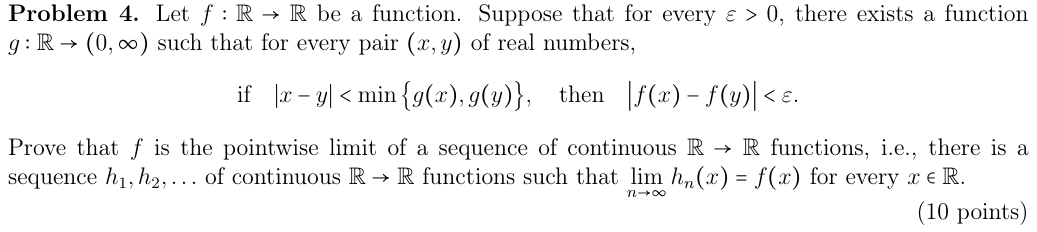
This transcription was compared symbol by symbol with the original, but not yet by a person.
Work for at least 45 minutes before opening the solution.
Official solution
(proposed by Camille Mau, Nanyang Technological University, Singapore)
Hint: Start from a segment in place of and use its compactness. Or recall the cool things called “the Lebesgue characterization theorem” and “the Baire characterization theorem”.
Solution 1. Since depends also on , let us use the notation . Considering only for positive integer will suffice to reach our conclusions, hence we may use in place of and thus assume decreasing in .
For any , choose . Of the -neighborhoods of all select (using local compactness of the reals) an inclusion-minimal locally finite covering . From its inclusion-minimality it follows that we may enumerate with so that only when and the enumeration goes from left to right on the real line. For an assumed , let be the center of and , so that and for all .
Now define a continuous so that it equals in , and so that changes continuously between and in the intersection .
Now we show that pointwise. Fix a point and , and choose
- belongs to the unique . Then using the monotonicity of in we have
Hence
- belongs to . Similar to the previous case,
Since is between and by construction, we have
We have that holds for sufficiently large , which proves the pointwise convergence.
Solution 2. This solution uses the Baire characterization theorem: A function is a pointwise limit of continuous functions if and only if its restriction to every non-empty closed subset of has a point of continuity.
Assume the contrary in view of the above theorem: is a non-empty closed set and has no point of continuity in . Let’s think that is defined only on .
Then for all there exist rationals for which , . Apply the Baire category theorem: If a complete metric space is a countable union of sets then some of the sets is dense in a positive radius metric ball of . It follows that there exist and , which serve for a subset which is dense on a certain ball (in the induced metric of the real line) . It yields that both sets and are dense in .
Choose and find for which the set is also dense on a certain ball . Partition into subsets where and , one of them is again dense somewhere in , say the latter.
Now take any point and a very close (within distance ) to point with but . This pair contradicts the property of from the problem statement.
Solution 3. This solution uses the Lebesgue characterization theorem: If is a function and, for all real , the sublevel and superlevel sets , are countable intersections of open sets then is a pointwise limit of continuous functions.
Now the solution follows from the formula with a countable intersection of the unions of intervals:
The left hand side is obviously contained in the right hand side, just put .
To prove the opposite inclusion assume the contrary, that , but is contained in the right hand side. Choose a positive integer such that and such that . Then, since belongs to the right hand side, we see that there exists such that and
Transcribed from the official solutions, pages 4–5. This transcription has not been checked a second time; if in doubt, look at the original.
Archive problem: the statement is the official text (transcribed, with the original above). Subject classification and difficulty were estimated automatically; hints and a worked solution are added over time.
How did it go?
Moves you mark come back sooner in triage.