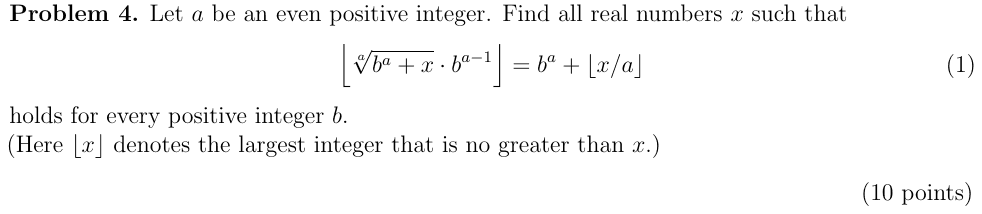
Let a be an even positive integer. Find all real numbers x such that
⌊aba+x⋅ba−1⌋=ba+⌊x/a⌋(1)
holds for every positive integer b. (Here ⌊x⌋ denotes the largest integer that is no greater than x.)
Πρωτότυπο από το επίσημο PDF
Η μεταγραφή συγκρίθηκε σύμβολο προς σύμβολο με το πρωτότυπο, όχι ακόμα από άνθρωπο.
Χρόνος σε αυτό το θέμα
Δούλεψε τουλάχιστον 45 λεπτά πριν ανοίξεις τη λύση.
Επίσημη λύση
(proposed by Yagub Aliyev, ADA University, Baku, Azerbaijan)
Solution. We will show that if a=2 then we must have x∈[−1,2)∪[3,4), otherwise x∈[−1,a).
Suppose that ⌊x/a⌋=m. Then m≤x/a<m+1, and
am≤x<a(m+1).(2)
Let b=1. Then
⌊a1+x⌋=1+⌊x/a⌋.(3)
From (3) it follows that ⌊a1+x⌋=1+m, or 1+m≤a1+x<2+m, or
(1+m)a−1≤x<(2+m)a−1,(4)
where we have used the obvious fact that m≥−1. Indeed, the number a1+x and therefore the number ⌊a1+x⌋=1+m is not negative. By Bernoulli's inequality, the following two inequalities — which compare the inequalities (2) and (4) — hold:
am≤(1+m)a−1,(5)
a(m+1)≤(1+(m+1))a−1,(6)
where in (5), equality holds if and only if m=0, and in (6), equality holds if and only if m=−1. From (2), (4)–(6), it follows that
(m+1)a−1≤x<a(m+1).(7)
From (7), it follows that (m+1)a−1<a(m+1). Therefore
(m+1)a≤a(m+1).(8)
From (8), it follows that m+1≤aa−11. If a>2 then m+1<aa−11<2, because 2a−1>a for a>2 (one can prove this by mathematical induction) and 1<aa−11<2 is not an integer. Therefore, if a>2 then m=0 or m=−1. If a=2 then m=−1, m=0 or m=1. From (7), it follows that the equality (3) holds true only for the values −1≤x<0(m=−1), 0≤x<a(m=0) if a>2, and −1≤x<0(m=−1), 0≤x<2(m=0) and 3≤x<4(m=1) if a=2.
We will now prove that for these values of x, the equality (1) is true for all positive integers b. From (7), it follows that ba+(m+1)a−1≤ba+x<ba+a(m+1) and
1+ba(m+1)a−1≤1+bax<1+baa(m+1).(9)
By Bernoulli's inequality
1+baa(m+1)≤(1+bam+1)a,(10)
where equality occurs if and only if m=−1. It is easy to check that for m=1 (if a=2), m=0 and m=−1, the following inequality holds true:
Μεταγραφή από το επίσημο κείμενο λύσεων, σελίδες 4–6. Η μεταγραφή δεν έχει ελεγχθεί δεύτερη φορά· αν έχεις αμφιβολία, κοίτα το πρωτότυπο.
Θέμα αρχείου: η εκφώνηση είναι το επίσημο κείμενο (μεταγραμμένο, με το πρωτότυπο παραπάνω). Η ταξινόμηση ανά αντικείμενο και η δυσκολία εκτιμήθηκαν αυτόματα· υποδείξεις και λύση στα ελληνικά προστίθενται σταδιακά.
Πώς πήγε;
Οι κινήσεις που σημειώνεις επιστρέφουν νωρίτερα στη διαλογή.