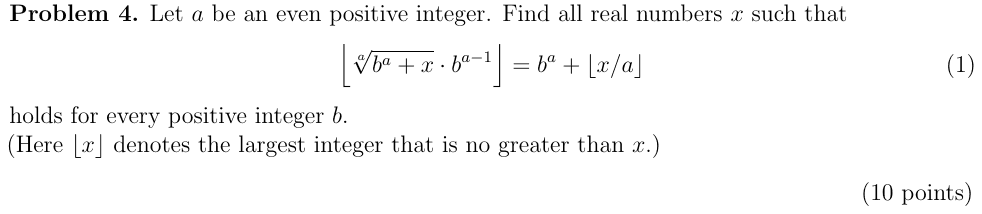
Let a be an even positive integer. Find all real numbers x such that
⌊aba+x⋅ba−1⌋=ba+⌊x/a⌋(1)
holds for every positive integer b. (Here ⌊x⌋ denotes the largest integer that is no greater than x.)
Original from the official PDF
This transcription was compared symbol by symbol with the original, but not yet by a person.
Time on this problem
Work for at least 45 minutes before opening the solution.
Official solution
(proposed by Yagub Aliyev, ADA University, Baku, Azerbaijan)
Solution. We will show that if a=2 then we must have x∈[−1,2)∪[3,4), otherwise x∈[−1,a).
Suppose that ⌊x/a⌋=m. Then m≤x/a<m+1, and
am≤x<a(m+1).(2)
Let b=1. Then
⌊a1+x⌋=1+⌊x/a⌋.(3)
From (3) it follows that ⌊a1+x⌋=1+m, or 1+m≤a1+x<2+m, or
(1+m)a−1≤x<(2+m)a−1,(4)
where we have used the obvious fact that m≥−1. Indeed, the number a1+x and therefore the number ⌊a1+x⌋=1+m is not negative. By Bernoulli's inequality, the following two inequalities — which compare the inequalities (2) and (4) — hold:
am≤(1+m)a−1,(5)
a(m+1)≤(1+(m+1))a−1,(6)
where in (5), equality holds if and only if m=0, and in (6), equality holds if and only if m=−1. From (2), (4)–(6), it follows that
(m+1)a−1≤x<a(m+1).(7)
From (7), it follows that (m+1)a−1<a(m+1). Therefore
(m+1)a≤a(m+1).(8)
From (8), it follows that m+1≤aa−11. If a>2 then m+1<aa−11<2, because 2a−1>a for a>2 (one can prove this by mathematical induction) and 1<aa−11<2 is not an integer. Therefore, if a>2 then m=0 or m=−1. If a=2 then m=−1, m=0 or m=1. From (7), it follows that the equality (3) holds true only for the values −1≤x<0(m=−1), 0≤x<a(m=0) if a>2, and −1≤x<0(m=−1), 0≤x<2(m=0) and 3≤x<4(m=1) if a=2.
We will now prove that for these values of x, the equality (1) is true for all positive integers b. From (7), it follows that ba+(m+1)a−1≤ba+x<ba+a(m+1) and
1+ba(m+1)a−1≤1+bax<1+baa(m+1).(9)
By Bernoulli's inequality
1+baa(m+1)≤(1+bam+1)a,(10)
where equality occurs if and only if m=−1. It is easy to check that for m=1 (if a=2), m=0 and m=−1, the following inequality holds true:
Transcribed from the official solutions, pages 4–6. This transcription has not been checked a second time; if in doubt, look at the original.
Archive problem: the statement is the official text (transcribed, with the original above). Subject classification and difficulty were estimated automatically; hints and a worked solution are added over time.