uniolympiads English

SEEMOUS 2020, Θέμα 1

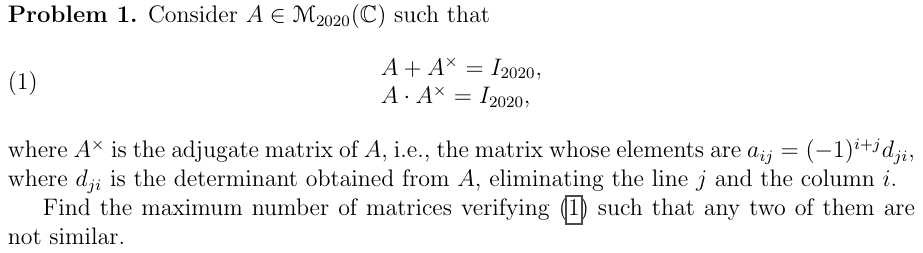
Consider A∈M2020(C)A \in \mathcal{M}_{2020}(\mathbb{C}) such that

A+A×=I2020,A⋅A×=I2020,(1)\begin{aligned} A + A^{\times} &= I_{2020}, \\ A \cdot A^{\times} &= I_{2020}, \end{aligned} \tag{1}

where A×A^{\times} is the adjugate matrix of AA, i.e., the matrix whose elements are aij=(−1)i+jdjia_{ij} = (-1)^{i+j} d_{ji}, where djid_{ji} is the determinant obtained from AA, eliminating the line jj and the column ii.

Find the maximum number of matrices verifying (1) such that any two of them are not similar.

Πρωτότυπο από το επίσημο PDFConsider A ∈ M 2020 (C) such that A + A × = I 2020 , A · A × = I 2020 , (1) where A × is the adjugate matrix of A, i.e., the matrix whose elements are a ij = (−1) i+j d ji , where d ji is the determinant obtained from A, eliminating the line j and the column i. Find the maximum number of matrices verifying (1) such that any two of them are not similar.

Η μεταγραφή συγκρίθηκε σύμβολο προς σύμβολο με το πρωτότυπο, όχι ακόμα από άνθρωπο.

Χρόνος σε αυτό το θέμα 0:00

Δούλεψε τουλάχιστον 45 λεπτά πριν ανοίξεις τη λύση.

Επίσημη λύση

Solution. It is known that

A⋅A×=det⁡A⋅I2020,A\cdot A^{\times} = \det A\cdot I_{2020},
hence, from the second relation we get det⁡A=1\det A = 1, so AA is invertible. Next, multiplying in the first relation by AA, we get
A2−A+I2020=O2020.A^2 - A + I_{2020} = \mathcal{O}_{2020}.
It follows that the minimal polynomial of AA divides
X2−X+1=(X−ω)(X−ωˉ),X^2 - X + 1 = (X-\omega)(X-\bar{\omega}),
where
ω=12+i32=cos⁡π3+isin⁡π3.\omega = \frac{1}{2} + i\frac{\sqrt{3}}{2} = \cos\frac{\pi}{3} + i\sin\frac{\pi}{3}.
Because the factors of the minimal polynomial of AA are of degree 1, it follows that AA is diagonalizable, so AA is similar to a matrix of the form
Ak=(ωIkOk,2020−kO2020−k,kωˉIn−k),k∈{0,1,...,2020}.A_k = \begin{pmatrix} \omega I_k & \mathcal{O}_{k,2020-k} \\ \mathcal{O}_{2020-k,k} & \bar{\omega} I_{n-k} \end{pmatrix}, \quad k\in\{0,1,...,2020\}.
But det⁡A=1\det A = 1, so we must have
ωkωˉ2020−k=1⇔ω2k−2020=1⇔cos⁡(2k−2020)π3+isin⁡(2k−2020)π3=1⇔cos⁡(2k+2)π3+isin⁡(2k+2)π3=1⇔k=3n+2∈{0,...,2020}⇔k∈{2,5,8,...,2018}\begin{aligned} \omega^k\bar{\omega}^{2020-k} &= 1 \Leftrightarrow \omega^{2k-2020} = 1 \Leftrightarrow \cos\frac{(2k-2020)\pi}{3} + i\sin\frac{(2k-2020)\pi}{3} = 1 \\ &\Leftrightarrow \cos\frac{(2k+2)\pi}{3} + i\sin\frac{(2k+2)\pi}{3} = 1 \\ &\Leftrightarrow k = 3n+2 \in \{0,...,2020\} \Leftrightarrow k\in\{2,5,8,...,2018\} \end{aligned}
Two matrices that verify the given relations are not similar if and only if the numbers k1,k2k_1, k_2 corresponding to those matrices are different, so the required maximum number of matrices is 673.

Μεταγραφή από το επίσημο κείμενο λύσεων, σελίδες 1–2. Η μεταγραφή δεν έχει ελεγχθεί δεύτερη φορά· αν έχεις αμφιβολία, κοίτα το πρωτότυπο.

Θέμα αρχείου: η εκφώνηση είναι το επίσημο κείμενο (μεταγραμμένο, με το πρωτότυπο παραπάνω). Η ταξινόμηση ανά αντικείμενο και η δυσκολία εκτιμήθηκαν αυτόματα· υποδείξεις και λύση στα ελληνικά προστίθενται σταδιακά.

Πώς πήγε;