uniolympiads Ελληνικά

SEEMOUS 2020, Problem 1

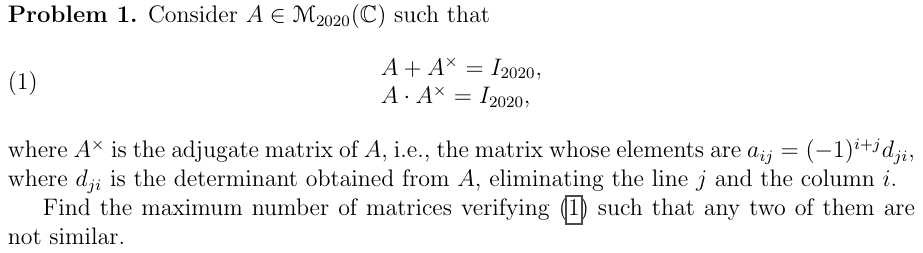
Consider A∈M2020(C)A \in \mathcal{M}_{2020}(\mathbb{C}) such that

A+A×=I2020,A⋅A×=I2020,(1)\begin{aligned} A + A^{\times} &= I_{2020}, \\ A \cdot A^{\times} &= I_{2020}, \end{aligned} \tag{1}

where A×A^{\times} is the adjugate matrix of AA, i.e., the matrix whose elements are aij=(−1)i+jdjia_{ij} = (-1)^{i+j} d_{ji}, where djid_{ji} is the determinant obtained from AA, eliminating the line jj and the column ii.

Find the maximum number of matrices verifying (1) such that any two of them are not similar.

Original from the official PDFConsider A ∈ M 2020 (C) such that A + A × = I 2020 , A · A × = I 2020 , (1) where A × is the adjugate matrix of A, i.e., the matrix whose elements are a ij = (−1) i+j d ji , where d ji is the determinant obtained from A, eliminating the line j and the column i. Find the maximum number of matrices verifying (1) such that any two of them are not similar.

This transcription was compared symbol by symbol with the original, but not yet by a person.

Time on this problem 0:00

Work for at least 45 minutes before opening the solution.

Official solution

Solution. It is known that

A⋅A×=det⁡A⋅I2020,A\cdot A^{\times} = \det A\cdot I_{2020},
hence, from the second relation we get det⁡A=1\det A = 1, so AA is invertible. Next, multiplying in the first relation by AA, we get
A2−A+I2020=O2020.A^2 - A + I_{2020} = \mathcal{O}_{2020}.
It follows that the minimal polynomial of AA divides
X2−X+1=(X−ω)(X−ωˉ),X^2 - X + 1 = (X-\omega)(X-\bar{\omega}),
where
ω=12+i32=cos⁡π3+isin⁡π3.\omega = \frac{1}{2} + i\frac{\sqrt{3}}{2} = \cos\frac{\pi}{3} + i\sin\frac{\pi}{3}.
Because the factors of the minimal polynomial of AA are of degree 1, it follows that AA is diagonalizable, so AA is similar to a matrix of the form
Ak=(ωIkOk,2020−kO2020−k,kωˉIn−k),k∈{0,1,...,2020}.A_k = \begin{pmatrix} \omega I_k & \mathcal{O}_{k,2020-k} \\ \mathcal{O}_{2020-k,k} & \bar{\omega} I_{n-k} \end{pmatrix}, \quad k\in\{0,1,...,2020\}.
But det⁡A=1\det A = 1, so we must have
ωkωˉ2020−k=1⇔ω2k−2020=1⇔cos⁡(2k−2020)π3+isin⁡(2k−2020)π3=1⇔cos⁡(2k+2)π3+isin⁡(2k+2)π3=1⇔k=3n+2∈{0,...,2020}⇔k∈{2,5,8,...,2018}\begin{aligned} \omega^k\bar{\omega}^{2020-k} &= 1 \Leftrightarrow \omega^{2k-2020} = 1 \Leftrightarrow \cos\frac{(2k-2020)\pi}{3} + i\sin\frac{(2k-2020)\pi}{3} = 1 \\ &\Leftrightarrow \cos\frac{(2k+2)\pi}{3} + i\sin\frac{(2k+2)\pi}{3} = 1 \\ &\Leftrightarrow k = 3n+2 \in \{0,...,2020\} \Leftrightarrow k\in\{2,5,8,...,2018\} \end{aligned}
Two matrices that verify the given relations are not similar if and only if the numbers k1,k2k_1, k_2 corresponding to those matrices are different, so the required maximum number of matrices is 673.

Transcribed from the official solutions, pages 1–2. This transcription has not been checked a second time; if in doubt, look at the original.

Archive problem: the statement is the official text (transcribed, with the original above). Subject classification and difficulty were estimated automatically; hints and a worked solution are added over time.
How did it go?