uniolympiads Ελληνικά

IMC 1994, Day 2, Problem 2

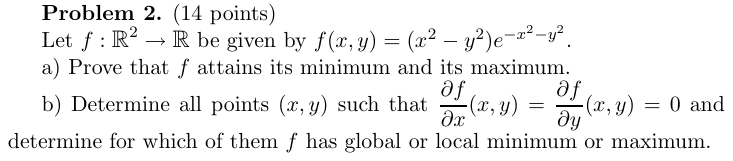
Let f ⁣:R2→Rf\colon \mathbb{R}^2 \to \mathbb{R} be given by f(x,y)=(x2−y2)e−x2−y2f(x, y) = (x^2 - y^2)e^{-x^2 - y^2}.

a) Prove that ff attains its minimum and its maximum.

b) Determine all points (x,y)(x, y) such that ∂f∂x(x,y)=∂f∂y(x,y)=0\dfrac{\partial f}{\partial x}(x, y) = \dfrac{\partial f}{\partial y}(x, y) = 0 and determine for which of them ff has global or local minimum or maximum.

Original from the official PDF(14 points) 2 2 Let f : R 2 → R be given by f (x, y) = (x 2 − y 2 )e −x −y . a) Prove that f attains its minimum and its maximum. ∂f ∂f b) Determine all points (x, y) such that (x, y) = (x, y) = 0 and ∂x ∂y determine for which of them f has global or local minimum or maximum.

This transcription was compared symbol by symbol with the original, but not yet by a person.

Time on this problem 0:00

Work for at least 45 minutes before opening the solution.

Official solution

Solution. We have f(1,0)=e−1f(1,0)=e^{-1}, f(0,1)=−e−1f(0,1)=-e^{-1} and te−t≤2e−2te^{-t}\le 2e^{-2} for t≥2t\ge 2. Therefore ∣f(x,y)∣≤(x2+y2)e−x2−y2≤2e−2<e−1|f(x,y)|\le(x^2+y^2)e^{-x^2-y^2}\le 2e^{-2}<e^{-1} for (x,y)∉M={(u,v) : u2+v2≤2}(x,y)\notin M=\{(u,v)\ :\ u^2+v^2\le 2\} and ff cannot attain its minimum and its maximum outside MM. Part a) follows from the compactness of MM and the continuity of ff. Let (x,y)(x,y) be a point from part b). From ∂f∂x(x,y)=2x(1−x2+y2)e−x2−y2\dfrac{\partial f}{\partial x}(x,y)=2x(1-x^2+y^2)e^{-x^2-y^2} we get

x(1−x2+y2)=0.(1)x(1-x^2+y^2)=0.\tag{1}
Similarly
y(1+x2−y2)=0.(2)y(1+x^2-y^2)=0.\tag{2}
All solutions (x,y)(x,y) of the system (1), (2) are (0,0)(0,0), (0,1)(0,1), (0,−1)(0,-1), (1,0)(1,0) and (−1,0)(-1,0). One has f(1,0)=f(−1,0)=e−1f(1,0)=f(-1,0)=e^{-1} and ff has global maximum at the points (1,0)(1,0) and (−1,0)(-1,0). One has f(0,1)=f(0,−1)=−e−1f(0,1)=f(0,-1)=-e^{-1} and ff has global minimum at the points (0,1)(0,1) and (0,−1)(0,-1). The point (0,0)(0,0) is not an extrema point because of f(x,0)=x2e−x2>0f(x,0)=x^2e^{-x^2}>0 if x≠0x\ne 0 and f(y,0)=−y2e−y2<0f(y,0)=-y^2e^{-y^2}<0 if y≠0y\ne 0.

Transcribed from the official solutions, pages 6–7. This transcription has not been checked a second time; if in doubt, look at the original.

Archive problem: the statement is the official text (transcribed, with the original above). Subject classification and difficulty were estimated automatically; hints and a worked solution are added over time.

How did it go?