uniolympiads Ελληνικά

IMC 1995, Day 2, Problem 4

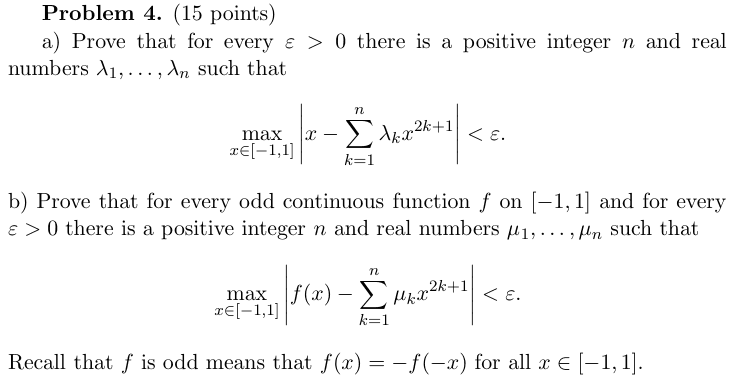
a) Prove that for every ε>0\varepsilon > 0 there is a positive integer nn and real numbers λ1,…,λn\lambda_1, \dots, \lambda_n such that

max⁡x∈[−1,1]∣x−∑k=1nλkx2k+1∣<ε.\max_{x \in [-1, 1]} \left| x - \sum_{k=1}^{n} \lambda_k x^{2k+1} \right| < \varepsilon.

b) Prove that for every odd continuous function ff on [−1,1][-1, 1] and for every ε>0\varepsilon > 0 there is a positive integer nn and real numbers μ1,…,μn\mu_1, \dots, \mu_n such that

max⁡x∈[−1,1]∣f(x)−∑k=1nμkx2k+1∣<ε.\max_{x \in [-1, 1]} \left| f(x) - \sum_{k=1}^{n} \mu_k x^{2k+1} \right| < \varepsilon.

Recall that ff is odd means that f(x)=−f(−x)f(x) = -f(-x) for all x∈[−1,1]x \in [-1, 1].

Original from the official PDF(15 points) a) Prove that for every ε > 0 there is a positive integer n and real numbers λ 1 , . . . , λ n such that max x∈[−1,1] x − n X λ k x 2k+1 < ε. k=1 b) Prove that for every odd continuous function f on [−1, 1] and for every ε > 0 there is a positive integer n and real numbers µ 1 , . . . , µ n such that max x∈[−1,1] f (x) − n X µ k x 2k+1 < ε. k=1 Recall that f is odd means that f (x) = −f (−x) for all x ∈ [−1, 1].

This transcription was compared symbol by symbol with the original, but not yet by a person.

Time on this problem 0:00

Work for at least 45 minutes before opening the solution.

Official solution

Solution. a) Let nn be such that (1−ε2)n≤ε(1-\varepsilon^2)^n\le\varepsilon. Then ∣x(1−x2)n∣<ε|x(1-x^2)^n|<\varepsilon for every x∈[−1,1]x\in[-1,1]. Thus one can set λk=(−1)k+1(nk)\lambda_k=(-1)^{k+1}\binom{n}{k} because then

x−∑k=1nλkx2k+1=∑k=0n(−1)k(nk)x2k+1=x(1−x2)n.x-\sum_{k=1}^n\lambda_kx^{2k+1}=\sum_{k=0}^n(-1)^k\binom{n}{k}x^{2k+1}=x(1-x^2)^n.

b) From the Weierstrass theorem there is a polynomial, say p∈Πmp\in\Pi_m, such that

max⁡x∈[−1,1]∣f(x)−p(x)∣<ε2.\max_{x\in[-1,1]}|f(x)-p(x)|<\frac{\varepsilon}{2}.
Set q(x)=12{p(x)−p(−x)}q(x)=\frac{1}{2}\{p(x)-p(-x)\}. Then
f(x)−q(x)=12{f(x)−p(x)}−12{f(−x)−p(−x)}f(x)-q(x)=\frac{1}{2}\{f(x)-p(x)\}-\frac{1}{2}\{f(-x)-p(-x)\}
and
max⁡∣x∣≤1∣f(x)−q(x)∣≤12max⁡∣x∣≤1∣f(x)−p(x)∣+12max⁡∣x∣≤1∣f(−x)−p(−x)∣<ε2.(1)\max_{|x|\le1}|f(x)-q(x)|\le\frac{1}{2}\max_{|x|\le1}|f(x)-p(x)|+\frac{1}{2}\max_{|x|\le1}|f(-x)-p(-x)|<\frac{\varepsilon}{2}.\tag{1}
But qq is an odd polynomial in Πm\Pi_m and it can be written as
q(x)=∑k=0mbkx2k+1=b0x+∑k=1mbkx2k+1.q(x)=\sum_{k=0}^mb_kx^{2k+1}=b_0x+\sum_{k=1}^mb_kx^{2k+1}.
If b0=0b_0=0 then (1) proves b). If b0≠0b_0\ne0 then one applies a) with ε2∣b0∣\frac{\varepsilon}{2|b_0|} instead of ε\varepsilon to get
max⁡∣x∣≤1∣b0x−∑k=1nb0λkx2k+1∣<ε2(2)\max_{|x|\le1}\left|b_0x-\sum_{k=1}^nb_0\lambda_kx^{2k+1}\right|<\frac{\varepsilon}{2}\tag{2}
for appropriate nn and λ1,λ2,…,λn\lambda_1,\lambda_2,\dots,\lambda_n. Now b) follows from (1) and (2) with max⁡{n,m}\max\{n,m\} instead of nn.

Transcribed from the official solutions, pages 8–9. This transcription has not been checked a second time; if in doubt, look at the original.

Archive problem: the statement is the official text (transcribed, with the original above). Subject classification and difficulty were estimated automatically; hints and a worked solution are added over time.

How did it go?