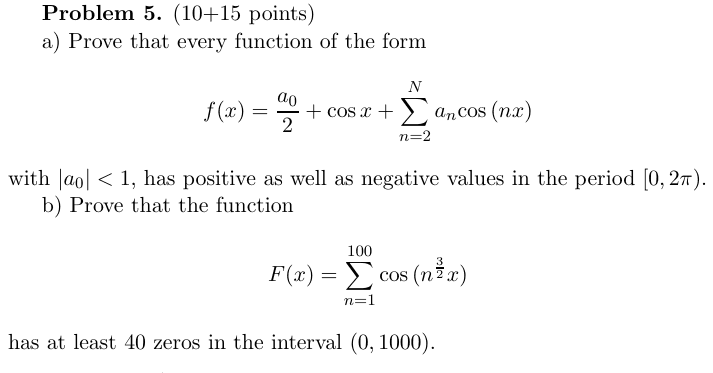
Solution. a) Let us consider the integral
∫ 0 2 π f ( x ) ( 1 ± cos x ) d x = π ( a 0 ± 1 ) . \int_0^{2\pi}f(x)(1\pm\cos x)dx=\pi(a_0\pm1). ∫ 0 2 π f ( x ) ( 1 ± cos x ) d x = π ( a 0 ± 1 ) .
The assumption that
f ( x ) ≥ 0 f(x)\ge0 f ( x ) ≥ 0 implies
a 0 ≥ 1 a_0\ge1 a 0 ≥ 1 . Similarly, if
f ( x ) ≤ 0 f(x)\le0 f ( x ) ≤ 0 then
a 0 ≤ − 1 a_0\le-1 a 0 ≤ − 1 . In both cases we have a contradiction with the hypothesis of the problem.
b) We shall prove that for each integer N N N h ≥ 24 h\ge24 h ≥ 24 y y y
F N ( x ) = ∑ n = 1 N cos ( x n 3 2 ) F_N(x)=\sum_{n=1}^N\cos(xn^{\frac{3}{2}}) F N ( x ) = n = 1 ∑ N cos ( x n 2 3 )
changes sign in the interval
( y , y + h ) (y,y+h) ( y , y + h ) . The assertion will follow immediately from here.
Consider the integrals
I 1 = ∫ y y + h F N ( x ) d x , I 2 = ∫ y y + h F N ( x ) cos x d x . I_1=\int_y^{y+h}F_N(x)dx,\qquad I_2=\int_y^{y+h}F_N(x)\cos x\,dx. I 1 = ∫ y y + h F N ( x ) d x , I 2 = ∫ y y + h F N ( x ) cos x d x .
If
F N ( x ) F_N(x) F N ( x ) does not change sign in
( y , y + h ) (y,y+h) ( y , y + h ) then we have
∣ I 2 ∣ ≤ ∫ y y + h ∣ F N ( x ) ∣ d x = ∣ ∫ y y + h F N ( x ) d x ∣ = ∣ I 1 ∣ . |I_2|\le\int_y^{y+h}|F_N(x)|dx=\left|\int_y^{y+h}F_N(x)dx\right|=|I_1|. ∣ I 2 ∣ ≤ ∫ y y + h ∣ F N ( x ) ∣ d x = ∫ y y + h F N ( x ) d x = ∣ I 1 ∣.
Hence, it is enough to prove that
∣ I 2 ∣ > ∣ I 1 ∣ . |I_2|>|I_1|. ∣ I 2 ∣ > ∣ I 1 ∣.
Obviously, for each
α ≠ 0 \alpha\ne0 α = 0 we have
∣ ∫ y y + h cos ( α x ) d x ∣ ≤ 2 ∣ α ∣ . \left|\int_y^{y+h}\cos(\alpha x)dx\right|\le\frac{2}{|\alpha|}. ∫ y y + h cos ( αx ) d x ≤ ∣ α ∣ 2 .
Hence
∣ I 1 ∣ = ∣ ∑ n = 1 N ∫ y y + h cos ( x n 3 2 ) d x ∣ ≤ 2 ∑ n = 1 N 1 n 3 2 < 2 ( 1 + ∫ 1 ∞ d t t 3 2 ) = 6. (1) |I_1|=\left|\sum_{n=1}^N\int_y^{y+h}\cos(xn^{\frac{3}{2}})dx\right|\le2\sum_{n=1}^N\frac{1}{n^{\frac{3}{2}}}<2\left(1+\int_1^\infty\frac{dt}{t^{\frac{3}{2}}}\right)=6.\tag{1} ∣ I 1 ∣ = n = 1 ∑ N ∫ y y + h cos ( x n 2 3 ) d x ≤ 2 n = 1 ∑ N n 2 3 1 < 2 ( 1 + ∫ 1 ∞ t 2 3 d t ) = 6. ( 1 )
On the other hand we have
I 2 = ∑ n = 1 N ∫ y y + h cos x cos ( x n 3 2 ) d x = 1 2 ∫ y y + h ( 1 + cos ( 2 x ) ) d x + + 1 2 ∑ n = 2 N ∫ y y + h ( cos ( x ( n 3 2 − 1 ) ) + cos ( x ( n 3 2 + 1 ) ) ) d x = 1 2 h + Δ , \begin{aligned}
I_2&=\sum_{n=1}^N\int_y^{y+h}\cos x\cos(xn^{\frac{3}{2}})dx\\
&=\frac{1}{2}\int_y^{y+h}(1+\cos(2x))dx+\\
&\quad+\frac{1}{2}\sum_{n=2}^N\int_y^{y+h}\left(\cos\left(x(n^{\frac{3}{2}}-1)\right)+\cos\left(x(n^{\frac{3}{2}}+1)\right)\right)dx\\
&=\frac{1}{2}h+\Delta,
\end{aligned} I 2 = n = 1 ∑ N ∫ y y + h cos x cos ( x n 2 3 ) d x = 2 1 ∫ y y + h ( 1 + cos ( 2 x )) d x + + 2 1 n = 2 ∑ N ∫ y y + h ( cos ( x ( n 2 3 − 1 ) ) + cos ( x ( n 2 3 + 1 ) ) ) d x = 2 1 h + Δ ,
where
∣ Δ ∣ ≤ 1 2 ( 1 + 2 ∑ n = 2 N ( 1 n 3 2 − 1 + 1 n 3 2 + 1 ) ) ≤ 1 2 + 2 ∑ n = 2 N 1 n 3 2 − 1 . |\Delta|\le\frac{1}{2}\left(1+2\sum_{n=2}^N\left(\frac{1}{n^{\frac{3}{2}}-1}+\frac{1}{n^{\frac{3}{2}}+1}\right)\right)\le\frac{1}{2}+2\sum_{n=2}^N\frac{1}{n^{\frac{3}{2}}-1}. ∣Δ∣ ≤ 2 1 ( 1 + 2 n = 2 ∑ N ( n 2 3 − 1 1 + n 2 3 + 1 1 ) ) ≤ 2 1 + 2 n = 2 ∑ N n 2 3 − 1 1 .
We use that
n 3 2 − 1 ≥ 2 3 n 3 2 n^{\frac{3}{2}}-1\ge\frac{2}{3}n^{\frac{3}{2}} n 2 3 − 1 ≥ 3 2 n 2 3 for
n ≥ 3 n\ge3 n ≥ 3 and we get
∣ Δ ∣ ≤ 1 2 + 2 2 3 2 − 1 + 3 ∑ n = 3 N 1 n 3 2 < 1 2 + 2 2 2 − 1 + 3 ∫ 2 ∞ d t t 3 2 < 6. |\Delta|\le\frac{1}{2}+\frac{2}{2^{\frac{3}{2}}-1}+3\sum_{n=3}^N\frac{1}{n^{\frac{3}{2}}}<\frac{1}{2}+\frac{2}{2\sqrt{2}-1}+3\int_2^\infty\frac{dt}{t^{\frac{3}{2}}}<6. ∣Δ∣ ≤ 2 1 + 2 2 3 − 1 2 + 3 n = 3 ∑ N n 2 3 1 < 2 1 + 2 2 − 1 2 + 3 ∫ 2 ∞ t 2 3 d t < 6.
Hence
∣ I 2 ∣ > 1 2 h − 6. (2) |I_2|>\frac{1}{2}h-6.\tag{2} ∣ I 2 ∣ > 2 1 h − 6. ( 2 )
We use that
h ≥ 24 h\ge24 h ≥ 24 and inequalities (1), (2) and we obtain
∣ I 2 ∣ > ∣ I 1 ∣ |I_2|>|I_1| ∣ I 2 ∣ > ∣ I 1 ∣ . The proof is completed.
Transcribed from the official solutions, pages 9–11. This transcription has not been checked a second time; if in doubt, look at the original.