IMC 1996, Day 1, Problem 3
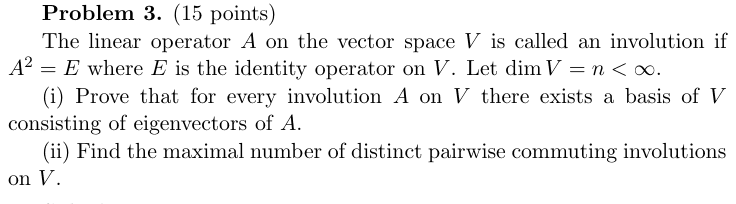
The linear operator on the vector space is called an involution if where is the identity operator on . Let .
(i) Prove that for every involution on there exists a basis of consisting of eigenvectors of .
(ii) Find the maximal number of distinct pairwise commuting involutions on .
Original from the official PDF
This transcription was compared symbol by symbol with the original, but not yet by a person.
Work for at least 45 minutes before opening the solution.
Official solution
Solution.
(i) Let . Then
Hence is a projection. Thus there exists a basis of eigenvectors for , and the matrix of in this basis is of the form .
Since the eigenvalues of are only.
(ii) Let be a set of commuting diagonalizable operators on , and let be one of these operators. Choose an eigenvalue of and denote . Then is a subspace of , and since for each we obtain that is invariant under each . If then is either or , and we can start with another operator . If we proceed by induction on in order to find a common eigenvector for all . Therefore are simultaneously diagonalizable.
If they are involutions then since the diagonal entries may equal 1 or -1 only.
Transcribed from the official solutions, page 4. This transcription has not been checked a second time; if in doubt, look at the original.
Archive problem: the statement is the official text (transcribed, with the original above). Subject classification and difficulty were estimated automatically; hints and a worked solution are added over time.
How did it go?
Moves you mark come back sooner in triage.