IMC 1996, Ημέρα 1, Θέμα 3
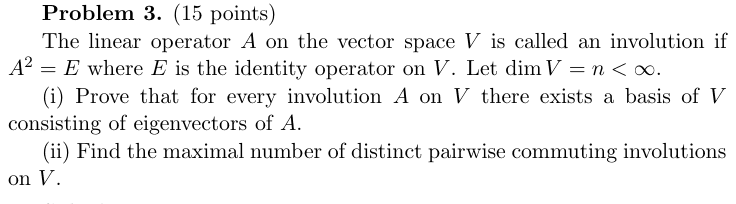
The linear operator on the vector space is called an involution if where is the identity operator on . Let .
(i) Prove that for every involution on there exists a basis of consisting of eigenvectors of .
(ii) Find the maximal number of distinct pairwise commuting involutions on .
Πρωτότυπο από το επίσημο PDF
Η μεταγραφή συγκρίθηκε σύμβολο προς σύμβολο με το πρωτότυπο, όχι ακόμα από άνθρωπο.
Δούλεψε τουλάχιστον 45 λεπτά πριν ανοίξεις τη λύση.
Επίσημη λύση
Solution.
(i) Let . Then
Hence is a projection. Thus there exists a basis of eigenvectors for , and the matrix of in this basis is of the form .
Since the eigenvalues of are only.
(ii) Let be a set of commuting diagonalizable operators on , and let be one of these operators. Choose an eigenvalue of and denote . Then is a subspace of , and since for each we obtain that is invariant under each . If then is either or , and we can start with another operator . If we proceed by induction on in order to find a common eigenvector for all . Therefore are simultaneously diagonalizable.
If they are involutions then since the diagonal entries may equal 1 or -1 only.
Μεταγραφή από το επίσημο κείμενο λύσεων, σελίδα 4. Η μεταγραφή δεν έχει ελεγχθεί δεύτερη φορά· αν έχεις αμφιβολία, κοίτα το πρωτότυπο.
Θέμα αρχείου: η εκφώνηση είναι το επίσημο κείμενο (μεταγραμμένο, με το πρωτότυπο παραπάνω). Η ταξινόμηση ανά αντικείμενο και η δυσκολία εκτιμήθηκαν αυτόματα· υποδείξεις και λύση στα ελληνικά προστίθενται σταδιακά.
Πώς πήγε;
Οι κινήσεις που σημειώνεις επιστρέφουν νωρίτερα στη διαλογή.