uniolympiads Ελληνικά

IMC 1996, Day 2, Problem 5

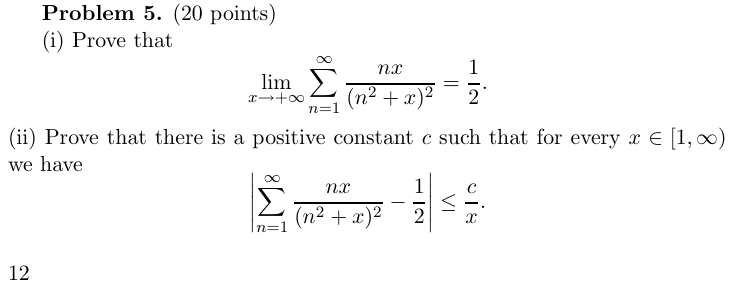
(i) Prove that

lim⁡x→+∞∑n=1∞nx(n2+x)2=12.\lim_{x \to +\infty} \sum_{n=1}^{\infty} \frac{nx}{(n^2 + x)^2} = \frac{1}{2}.

(ii) Prove that there is a positive constant cc such that for every x∈[1,∞)x \in [1, \infty) we have

∣∑n=1∞nx(n2+x)2−12∣≤cx.\left| \sum_{n=1}^{\infty} \frac{nx}{(n^2 + x)^2} - \frac{1}{2} \right| \le \frac{c}{x}.
Original from the official PDF(20 points) (i) Prove that lim x→+∞ ∞ X n=1 nx (n 2 + x) 2 = 1 . 2 (ii) Prove that there is a positive constant c such that for every x ∈ [1, ∞) we have ∞ X nx 1 c − ≤ . 2 2 (n + x) 2 x n=1 12

This transcription was compared symbol by symbol with the original, but not yet by a person.

Time on this problem 0:00

Work for at least 45 minutes before opening the solution.

Official solution

Solution.

(i) Set f(t)=t(1+t2)2f(t) = \dfrac{t}{(1+t^2)^2}, h=1xh = \dfrac{1}{\sqrt{x}}. Then

∑n=1∞nx(n2+x)2=h∑n=1∞f(nh)⟶h→0∫0∞f(t)dt=12.\sum_{n=1}^\infty \frac{nx}{(n^2+x)^2} = h \sum_{n=1}^\infty f(nh) \underset{h\to0}{\longrightarrow} \int_0^\infty f(t)dt = \frac12.

The convergence holds since h∑n=1∞f(nh)h \displaystyle\sum_{n=1}^\infty f(nh) is a Riemann sum of the integral ∫0∞f(t)dt\displaystyle\int_0^\infty f(t)dt. There are no problems with the infinite domain because ff is integrable and f↓0f \downarrow 0 for x→∞x \to \infty (thus h∑n=N∞f(nh)≥∫nN∞f(t)dt≥h∑n=N+1∞f(nh)h \displaystyle\sum_{n=N}^\infty f(nh) \geq \int_{nN}^\infty f(t)dt \geq h \sum_{n=N+1}^\infty f(nh)).

(ii) We have

∣∑n=1∞nx(n2+x)2−12∣=∣∑n=1∞(hf(nh)−∫nh−h2nh+h2f(t)dt)−∫0h2f(t)dt∣≤∑n=1∞∣hf(nh)−∫nh−h2nh+h2f(t)dt∣+∫0h2f(t)dt(1)\begin{aligned} \left| \sum_{n=1}^\infty \frac{nx}{(n^2+x)^2} - \frac12 \right| &= \left| \sum_{n=1}^\infty \left( hf(nh) - \int_{nh-\frac{h}{2}}^{nh+\frac{h}{2}} f(t)dt \right) - \int_0^{\frac{h}{2}} f(t)dt \right| \\ &\leq \sum_{n=1}^\infty \left| hf(nh) - \int_{nh-\frac{h}{2}}^{nh+\frac{h}{2}} f(t)dt \right| + \int_0^{\frac{h}{2}} f(t)dt \end{aligned} \tag{1}

Using twice integration by parts one has

2bg(a)−∫a−ba+bg(t)dt=−12∫0b(b−t)2(g′′(a+t)+g′′(a−t))dt(2)2bg(a) - \int_{a-b}^{a+b} g(t)dt = -\frac12 \int_0^b (b-t)^2 (g''(a+t) + g''(a-t))dt \tag{2}

for every g∈C2[a−b,a+b]g \in C^2[a-b, a+b]. Using f(0)=0f(0) = 0, f∈C2[0,h/2]f \in C^2[0, h/2] one gets

∫0h/2f(t)dt=O(h2).(3)\int_0^{h/2} f(t)dt = O(h^2). \tag{3}

From (1), (2) and (3) we get

∣∑n=1∞nx(n2+x)2−12∣≤∑n=1∞h2∫nh−h2nh+h2∣f′′(t)∣dt+O(h2)==h2∫h2∞∣f′′(t)∣dt+O(h2)=O(h2)=O(x−1).\begin{aligned} \left| \sum_{n=1}^\infty \frac{nx}{(n^2+x)^2} - \frac12 \right| &\leq \sum_{n=1}^\infty h^2 \int_{nh-\frac{h}{2}}^{nh+\frac{h}{2}} |f''(t)|dt + O(h^2) = \\ &= h^2 \int_{\frac{h}{2}}^\infty |f''(t)|dt + O(h^2) = O(h^2) = O(x^{-1}). \end{aligned}

Transcribed from the official solutions, pages 13–14. This transcription has not been checked a second time; if in doubt, look at the original.

Archive problem: the statement is the official text (transcribed, with the original above). Subject classification and difficulty were estimated automatically; hints and a worked solution are added over time.
How did it go?