uniolympiads Ελληνικά

IMC 1996, Day 2, Problem 4

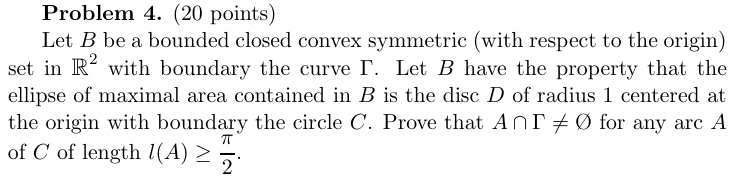
Let BB be a bounded closed convex symmetric (with respect to the origin) set in R2\mathbb{R}^2 with boundary the curve Γ\Gamma. Let BB have the property that the ellipse of maximal area contained in BB is the disc DD of radius 11 centered at the origin with boundary the circle CC. Prove that A∩Γ≠∅A \cap \Gamma \ne \emptyset for any arc AA of CC of length l(A)≥π2l(A) \ge \frac{\pi}{2}.

Original from the official PDF(20 points) Let B be a bounded closed convex symmetric (with respect to the origin) set in R 2 with boundary the curve Γ. Let B have the property that the ellipse of maximal area contained in B is the disc D of radius 1 centered at the origin with boundary the circle C. Prove that A ∩ Γ 6 = Ø for any arc A π of C of length l(A) ≥ . 2

This transcription was compared symbol by symbol with the original, but not yet by a person.

Time on this problem 0:00

Work for at least 45 minutes before opening the solution.

Official solution

Solution. Assume the contrary – there is an arc A⊂CA \subset C with length l(A)=π2l(A) = \dfrac{\pi}{2} such that A⊂B\ΓA \subset B \backslash \Gamma. Without loss of generality we may assume that the ends of AA are M=(1/2,1/2)M = (1/\sqrt{2}, 1/\sqrt{2}), N=(1/2,−1/2)N = (1/\sqrt{2}, -1/\sqrt{2}). AA is compact and Γ\Gamma is closed. From A∩Γ=ØA \cap \Gamma = \text{Ø} we get δ>0\delta > 0 such that dist⁡(x,y)>δ\operatorname{dist}(x, y) > \delta for every x∈Ax \in A, y∈Γy \in \Gamma.

Given ε>0\varepsilon > 0 with EεE_\varepsilon we denote the ellipse with boundary: x2(1+ε)2+y2b2=1\dfrac{x^2}{(1+\varepsilon)^2} + \dfrac{y^2}{b^2} = 1, such that M,N∈EεM, N \in E_\varepsilon. Since M∈EεM \in E_\varepsilon we get

b2=(1+ε)22(1+ε)2−1.b^2 = \frac{(1+\varepsilon)^2}{2(1+\varepsilon)^2 - 1}.

Then we have

area⁡Eε=π(1+ε)22(1+ε)2−1>π=area⁡D.\operatorname{area} E_\varepsilon = \pi \frac{(1+\varepsilon)^2}{\sqrt{2(1+\varepsilon)^2 - 1}} > \pi = \operatorname{area} D.

In view of the hypotheses, Eε∖B≠ØE_\varepsilon \setminus B \neq \text{Ø} for every ε>0\varepsilon > 0. Let S={(x,y)∈R2:∣x∣>∣y∣}S = \{(x, y) \in \mathbb{R}^2 : |x| > |y|\}. ¿From Eε∖S⊂D⊂BE_\varepsilon \setminus S \subset D \subset B it follows that Eε∖B⊂SE_\varepsilon \setminus B \subset S. Taking ε<δ\varepsilon < \delta we get that

Ø≠Eε∖B⊂Eε∩S⊂D1+ε∩S⊂B\text{Ø} \neq E_\varepsilon \setminus B \subset E_\varepsilon \cap S \subset D_{1+\varepsilon} \cap S \subset B

– a contradiction (we use the notation Dt={(x,y)∈R2:x2+y2≤t2}D_t = \{(x, y) \in \mathbb{R}^2 : x^2 + y^2 \leq t^2\}).

Remark. The ellipse with maximal area is well known as John’s ellipse. Any coincidence with the President of the Jury is accidental.

Transcribed from the official solutions, page 12. This transcription has not been checked a second time; if in doubt, look at the original.

Archive problem: the statement is the official text (transcribed, with the original above). Subject classification and difficulty were estimated automatically; hints and a worked solution are added over time.

How did it go?