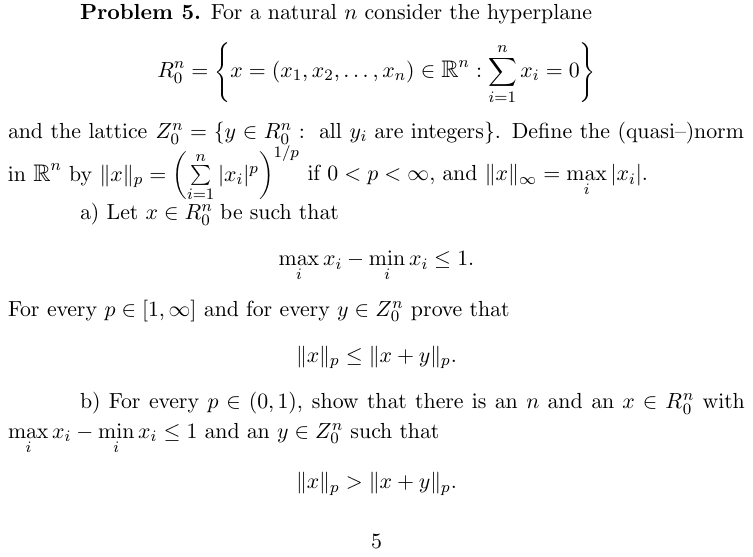
Solution. a) For x = 0 x = 0 x = 0 x ≠ 0 x \ne 0 x = 0 max i x i > 0 \max\limits_i x_i > 0 i max x i > 0 min i x i < 0 \min\limits_i x_i < 0 i min x i < 0 ∥ x ∥ ∞ < 1 \|x\|_\infty < 1 ∥ x ∥ ∞ < 1 x x x
i) If x j ≤ 0 x_j \le 0 x j ≤ 0 max i x i ≤ x j + 1 \max\limits_i x_i \le x_j + 1 i max x i ≤ x j + 1
ii) If x j ≥ 0 x_j \ge 0 x j ≥ 0 min i x i ≥ x j − 1 \min\limits_i x_i \ge x_j - 1 i min x i ≥ x j − 1
Consider y ∈ Z 0 n y \in Z_0^n y ∈ Z 0 n y ≠ 0 y \ne 0 y = 0 { 1 , 2 , … , n } \{1, 2, \ldots, n\} { 1 , 2 , … , n }
I ( 0 ) = { i : y i = 0 } , I ( + , + ) = { i : y i > 0 , x i ≥ 0 } , I ( + , − ) = { i : y i > 0 , x i < 0 } , I ( − , + ) = { i : y i < 0 , x i > 0 } , I ( − , − ) = { i : y i < 0 , x i ≤ 0 } . \begin{gathered}
I(0) = \{i : y_i = 0\}, \\
I(+,+) = \{i : y_i > 0, x_i \ge 0\}, \quad I(+,-) = \{i : y_i > 0, x_i < 0\}, \\
I(-,+) = \{i : y_i < 0, x_i > 0\}, \quad I(-,-) = \{i : y_i < 0, x_i \le 0\}.
\end{gathered} I ( 0 ) = { i : y i = 0 } , I ( + , + ) = { i : y i > 0 , x i ≥ 0 } , I ( + , − ) = { i : y i > 0 , x i < 0 } , I ( − , + ) = { i : y i < 0 , x i > 0 } , I ( − , − ) = { i : y i < 0 , x i ≤ 0 } .
As least one of the last four index sets is not empty. If
I ( + , + ) ≠ ∅ I(+,+) \ne \emptyset I ( + , + ) = ∅ or
I ( − , − ) ≠ ∅ I(-,-) \ne \emptyset I ( − , − ) = ∅ then
∥ x + y ∥ ∞ ≥ 1 > ∥ x ∥ ∞ \|x + y\|_\infty \ge 1 > \|x\|_\infty ∥ x + y ∥ ∞ ≥ 1 > ∥ x ∥ ∞ . If
I ( + , + ) = I ( − , − ) = ∅ I(+,+) = I(-,-) = \emptyset I ( + , + ) = I ( − , − ) = ∅ then
∑ y i = 0 \sum y_i = 0 ∑ y i = 0 implies
I ( + , − ) ≠ ∅ I(+,-) \ne \emptyset I ( + , − ) = ∅ and
I ( − , + ) ≠ ∅ I(-,+) \ne \emptyset I ( − , + ) = ∅ . Therefore i) and ii) give
∥ x + y ∥ ∞ ≥ ∥ x ∥ ∞ \|x + y\|_\infty \ge \|x\|_\infty ∥ x + y ∥ ∞ ≥ ∥ x ∥ ∞ which completes the case
p = ∞ p = \infty p = ∞ .
Now let 1 ≤ p < ∞ 1 \le p < \infty 1 ≤ p < ∞ j ∈ I ( + , − ) j \in I(+,-) j ∈ I ( + , − ) ∣ x j + y j ∣ = y j − 1 + x j + 1 ≥ ∣ y j ∣ − 1 + max i x i |x_j + y_j| = y_j - 1 + x_j + 1 \ge |y_j| - 1 + \max\limits_i x_i ∣ x j + y j ∣ = y j − 1 + x j + 1 ≥ ∣ y j ∣ − 1 + i max x i
∣ x j + y j ∣ p ≥ ∣ y j ∣ − 1 + ∣ x k ∣ p for every k ∈ I ( − , + ) and j ∈ I ( + , − ) . |x_j + y_j|^p \ge |y_j| - 1 + |x_k|^p \text{ for every } k \in I(-,+) \text{ and } j \in I(+,-). ∣ x j + y j ∣ p ≥ ∣ y j ∣ − 1 + ∣ x k ∣ p for every k ∈ I ( − , + ) and j ∈ I ( + , − ) .
Similarly
∣ x j + y j ∣ p ≥ ∣ y j ∣ − 1 + ∣ x k ∣ p for every k ∈ I ( + , − ) and j ∈ I ( − , + ) ; |x_j + y_j|^p \ge |y_j| - 1 + |x_k|^p \text{ for every } k \in I(+,-) \text{ and } j \in I(-,+); ∣ x j + y j ∣ p ≥ ∣ y j ∣ − 1 + ∣ x k ∣ p for every k ∈ I ( + , − ) and j ∈ I ( − , + ) ; ∣ x j + y j ∣ p ≥ ∣ y j ∣ + ∣ x j ∣ p for every j ∈ I ( + , + ) ∪ I ( − , − ) . |x_j + y_j|^p \ge |y_j| + |x_j|^p \text{ for every } j \in I(+,+) \cup I(-,-). ∣ x j + y j ∣ p ≥ ∣ y j ∣ + ∣ x j ∣ p for every j ∈ I ( + , + ) ∪ I ( − , − ) .
Assume that
∑ j ∈ I ( + , − ) 1 ≥ ∑ j ∈ I ( − , + ) 1 \sum\limits_{j \in I(+,-)} 1 \ge \sum\limits_{j \in I(-,+)} 1 j ∈ I ( + , − ) ∑ 1 ≥ j ∈ I ( − , + ) ∑ 1 . Then
∥ x + y ∥ p p − ∥ x ∥ p p = ∑ j ∈ I ( + , + ) ∪ I ( − , − ) ( ∣ x j + y j ∣ p − ∣ x j ∣ p ) + ( ∑ j ∈ I ( + , − ) ∣ x j + y j ∣ p − ∑ k ∈ I ( − , + ) ∣ x k ∣ p ) + ( ∑ j ∈ I ( − , + ) ∣ x j + y j ∣ p − ∑ k ∈ I ( + , − ) ∣ x k ∣ p ) ≥ ∑ j ∈ I ( + , + ) ∪ I ( − , − ) ∣ y j ∣ + ∑ j ∈ I ( + , − ) ( ∣ y j ∣ − 1 ) + ( ∑ j ∈ I ( − , + ) ( ∣ y j ∣ − 1 ) − ∑ j ∈ I ( + , − ) 1 + ∑ j ∈ I ( − , + ) 1 ) = ∑ i = 1 n ∣ y i ∣ − 2 ∑ j ∈ I ( + , − ) 1 = 2 ∑ j ∈ I ( + , − ) ( y j − 1 ) + 2 ∑ j ∈ I ( + , + ) y j ≥ 0. \begin{aligned}
&\|x + y\|_p^p - \|x\|_p^p \\
={}& \sum_{j \in I(+,+) \cup I(-,-)} (|x_j + y_j|^p - |x_j|^p) + \left(\sum_{j \in I(+,-)} |x_j + y_j|^p - \sum_{k \in I(-,+)} |x_k|^p\right) \\
&+ \left(\sum_{j \in I(-,+)} |x_j + y_j|^p - \sum_{k \in I(+,-)} |x_k|^p\right) \\
\ge{}& \sum_{j \in I(+,+) \cup I(-,-)} |y_j| + \sum_{j \in I(+,-)} (|y_j| - 1) \\
&+ \left(\sum_{j \in I(-,+)} (|y_j| - 1) - \sum_{j \in I(+,-)} 1 + \sum_{j \in I(-,+)} 1\right) \\
={}& \sum_{i=1}^n |y_i| - 2 \sum_{j \in I(+,-)} 1 = 2 \sum_{j \in I(+,-)} (y_j - 1) + 2 \sum_{j \in I(+,+)} y_j \ge 0.
\end{aligned} = ≥ = ∥ x + y ∥ p p − ∥ x ∥ p p j ∈ I ( + , + ) ∪ I ( − , − ) ∑ ( ∣ x j + y j ∣ p − ∣ x j ∣ p ) + j ∈ I ( + , − ) ∑ ∣ x j + y j ∣ p − k ∈ I ( − , + ) ∑ ∣ x k ∣ p + j ∈ I ( − , + ) ∑ ∣ x j + y j ∣ p − k ∈ I ( + , − ) ∑ ∣ x k ∣ p j ∈ I ( + , + ) ∪ I ( − , − ) ∑ ∣ y j ∣ + j ∈ I ( + , − ) ∑ ( ∣ y j ∣ − 1 ) + j ∈ I ( − , + ) ∑ ( ∣ y j ∣ − 1 ) − j ∈ I ( + , − ) ∑ 1 + j ∈ I ( − , + ) ∑ 1 i = 1 ∑ n ∣ y i ∣ − 2 j ∈ I ( + , − ) ∑ 1 = 2 j ∈ I ( + , − ) ∑ ( y j − 1 ) + 2 j ∈ I ( + , + ) ∑ y j ≥ 0.
The case
∑ j ∈ I ( + , − ) 1 ≤ ∑ j ∈ I ( − , + ) 1 \sum\limits_{j \in I(+,-)} 1 \le \sum\limits_{j \in I(-,+)} 1 j ∈ I ( + , − ) ∑ 1 ≤ j ∈ I ( − , + ) ∑ 1 is similar. This proves the statement.
b) Fix p ∈ ( 0 , 1 ) p \in (0,1) p ∈ ( 0 , 1 ) t ∈ ( 1 2 , 1 ) t \in (\frac12, 1) t ∈ ( 2 1 , 1 ) m m m l l l m t = l ( 1 − t ) mt = l(1 - t) m t = l ( 1 − t ) n = m + l n = m + l n = m + l
x i = t , i = 1 , 2 , … , m ; x i = t − 1 , i = m + 1 , m + 2 , … , n ; y i = − 1 , i = 1 , 2 , … , m ; y m + 1 = m ; y i = 0 , i = m + 2 , … , n . \begin{aligned}
&x_i = t, \quad i = 1, 2, \ldots, m; \quad x_i = t - 1, \quad i = m+1, m+2, \ldots, n; \\
&y_i = -1, \quad i = 1, 2, \ldots, m; \quad y_{m+1} = m; \quad y_i = 0, \ i = m+2, \ldots, n.
\end{aligned} x i = t , i = 1 , 2 , … , m ; x i = t − 1 , i = m + 1 , m + 2 , … , n ; y i = − 1 , i = 1 , 2 , … , m ; y m + 1 = m ; y i = 0 , i = m + 2 , … , n .
Then
x ∈ R 0 n x \in R_0^n x ∈ R 0 n ,
max i x i − min i x i = 1 \max\limits_i x_i - \min\limits_i x_i = 1 i max x i − i min x i = 1 ,
y ∈ Z 0 n y \in Z_0^n y ∈ Z 0 n and
∥ x ∥ p p − ∥ x + y ∥ p p = m ( t p − ( 1 − t ) p ) + ( 1 − t ) p − ( m − 1 + t ) p , \|x\|_p^p - \|x + y\|_p^p = m(t^p - (1-t)^p) + (1-t)^p - (m - 1 + t)^p, ∥ x ∥ p p − ∥ x + y ∥ p p = m ( t p − ( 1 − t ) p ) + ( 1 − t ) p − ( m − 1 + t ) p ,
which is possitive for
m m m big enough.
Transcribed from the official solutions, pages 6–7. This transcription has not been checked a second time; if in doubt, look at the original.