IMC 1997, Day 1, Problem 6
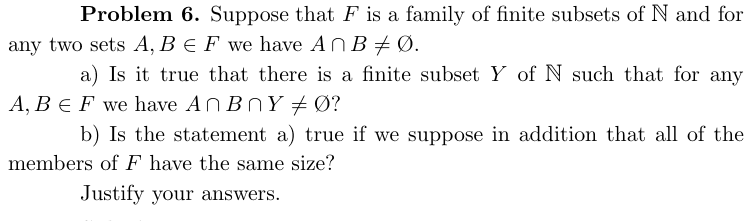
Suppose that is a family of finite subsets of and for any two sets we have .
a) Is it true that there is a finite subset of such that for any we have ?
b) Is the statement a) true if we suppose in addition that all of the members of have the same size?
Justify your answers.
Original from the official PDF
This transcription was compared symbol by symbol with the original, but not yet by a person.
Work for at least 45 minutes before opening the solution.
Official solution
Solution. a) No. Consider , where , .
b) Yes. We will prove inductively a stronger statement:
Suppose , are two families of finite subsets of such that: 1) For every and we have ; 2) All the elements of have the same size , and elements of – size . (we shall write , ). Then there is a finite set such that for every and .
The problem b) follows if we take .
Proof of the statement: The statement is obvious for . Fix the numbers , and suppose the statement is proved for all pairs , with , . Fix , . For any subset , denote
Indeed, if we denote by the corresponding finite set, then the finite set will satisfy the statement for and . The proof for and .
If , it is trivial.
If , then any two sets , must meet outside . Then if we denote , , then and satisfy the conditions 1) and 2) above, with , , and the inductive assumption works.
Transcribed from the official solutions, pages 7–8. This transcription has not been checked a second time; if in doubt, look at the original.
Archive problem: the statement is the official text (transcribed, with the original above). Subject classification and difficulty were estimated automatically; hints and a worked solution are added over time.
How did it go?
Moves you mark come back sooner in triage.