where C denotes the k×k-matrix with coefficients ci,j. Therefore, the determinant of any matrix of type (C) is a perfect square (up to a sign).
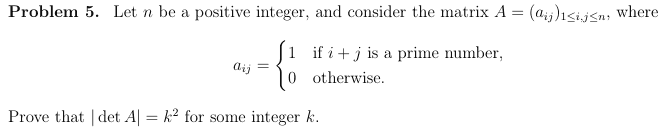
Now let X′ be the matrix obtained from A by replacing the first row by (100…0), and let Y be the matrix obtained from A by replacing the entry a11 by 0. By multi-linearity of the determinant, det(A)=det(X′)+det(Y). Note that X′ can be written as
X′=(1v0X)
for some (n−1)×(n−1)-matrix X and some column vector v. Then det(A)=det(X)+det(Y). Now consider two cases. If n is odd, then X is of type (C), and Y is of type (B). Therefore, ∣det(A)∣=∣det(X)∣ is a perfect square. If n is even, then X is of type (B), and Y is of type (C); hence ∣det(A)∣=∣det(Y)∣ is a perfect square.
The set of primes can be replaced by any subset of {2}∪{3,5,7,9,11,…}.
Transcribed from the official solutions, page 2. This transcription has not been checked a second time; if in doubt, look at the original.
Archive problem: the statement is the official text (transcribed, with the original above). Subject classification and difficulty were estimated automatically; hints and a worked solution are added over time.