uniolympiads Ελληνικά

IMC 2012, Day 2, Problem 2

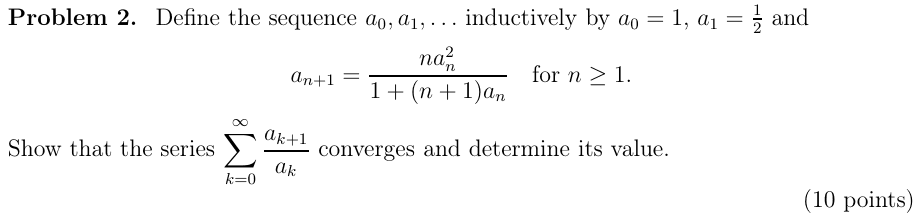
Define the sequence a0,a1,…a_0, a_1, \dots inductively by a0=1a_0 = 1, a1=12a_1 = \frac{1}{2} and

an+1=nan21+(n+1)anfor n≥1.a_{n+1} = \frac{na_n^2}{1 + (n+1)a_n} \quad \text{for } n \ge 1.

Show that the series ∑k=0∞ak+1ak\sum_{k=0}^{\infty} \frac{a_{k+1}}{a_k} converges and determine its value.

Original from the official PDFDefine the sequence a 0 , a 1 , . . . inductively by a 0 = 1, a 1 = 12 and na 2 n a n+1 = 1 + (n + 1)a n Show that the series ∞ X a k+1 k=0 a k for n ≥ 1. converges and determine its value.

This transcription was compared symbol by symbol with the original, but not yet by a person.

Time on this problem 0:00

Work for at least 45 minutes before opening the solution.

Official solution

(Proposed by Christophe Debry, KU Leuven, Belgium)

Solution. Observe that

kak=(1+(k+1)ak)ak+1ak=ak+1ak+(k+1)ak+1for all k≥1,ka_k=\frac{(1+(k+1)a_k)a_{k+1}}{a_k}=\frac{a_{k+1}}{a_k}+(k+1)a_{k+1}\quad\text{for all }k\ge 1,
and hence
∑k=0nak+1ak=a1a0+∑k=1n(kak−(k+1)ak+1)=12+1⋅a1−(n+1)an+1=1−(n+1)an+1(1)\sum_{k=0}^{n}\frac{a_{k+1}}{a_k}=\frac{a_1}{a_0}+\sum_{k=1}^{n}\big(ka_k-(k+1)a_{k+1}\big)=\frac12+1\cdot a_1-(n+1)a_{n+1}=1-(n+1)a_{n+1} \tag{1}
for all n≥0n\ge 0.

By (1) we have ∑k=0nak+1ak<1\sum\limits_{k=0}^{n}\frac{a_{k+1}}{a_k}<1. Since all terms are positive, this implies that the series ∑k=0∞ak+1ak\sum\limits_{k=0}^{\infty}\frac{a_{k+1}}{a_k} is convergent. The sequence of terms, ak+1ak\frac{a_{k+1}}{a_k} must converge to zero. In particular, there is an index n0n_0 such that ak+1ak<12\frac{a_{k+1}}{a_k}<\frac12 for n≥n0n\ge n_0. Then, by induction on nn, we have an<C2na_n<\frac{C}{2^n} with some positive constant CC. From nan<Cn2n→0na_n<\frac{Cn}{2^n}\to 0 we get nan→0na_n\to 0, and therefore

∑k=0∞ak+1ak=lim⁡n→∞∑k=0nak+1ak=lim⁡n→∞(1−(n+1)an+1)=1.\sum_{k=0}^{\infty}\frac{a_{k+1}}{a_k}=\lim_{n\to\infty}\sum_{k=0}^{n}\frac{a_{k+1}}{a_k}=\lim_{n\to\infty}\Big(1-(n+1)a_{n+1}\Big)=1.

Remark. The inequality an≤12na_n\le\frac{1}{2^n} can be proved by a direct induction as well.

Transcribed from the official solutions, pages 1–2. This transcription has not been checked a second time; if in doubt, look at the original.

Archive problem: the statement is the official text (transcribed, with the original above). Subject classification and difficulty were estimated automatically; hints and a worked solution are added over time.

How did it go?