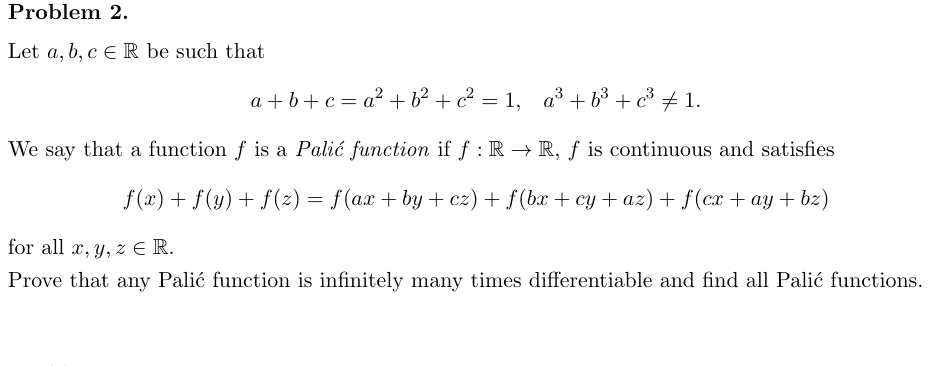
Prove that any Palić function is infinitely many times differentiable and find all Palić functions.
Original from the official PDF
This transcription was compared symbol by symbol with the original, but not yet by a person.
Time on this problem
Work for at least 45 minutes before opening the solution.
Official solution
Solution: First, it is easy to show that the given conditions imply that a, b and c are nonzero.
Let f be a Palić function. For z=0 in (P), we obtain
f(x)+f(y)+f(0)=f(ax+by)+f(bx+cy)+f(cx+ay)(1)
for all x,y∈R. Since f is continuous, it follows that F(x)=∫0xf(t)dt is a primitive of f. By integrating (1) on [0,1] with respect to y, it follows that
for all x,y∈R. Since F is differentiable, it follows from (2) that f is also differentiable, hence F is twice differentiable. By repeating the argument (using (2)), we easily obtain that f is infinitely many times differentiable.
Next, we differentiate in (P) three times with respect to x to obtain
for all x,y,z∈R, so any function f of the form (3) is a Palić function.
Transcribed from the official solutions, pages 2–3. This transcription has not been checked a second time; if in doubt, look at the original.
Archive problem: the statement is the official text (transcribed, with the original above). Subject classification and difficulty were estimated automatically; hints and a worked solution are added over time.