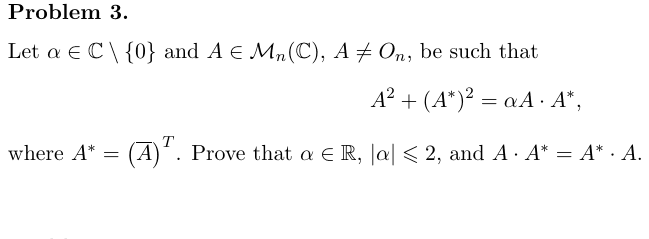
Solution: Let A = ( a i j ) 1 ⩽ i , j ⩽ n A = (a_{ij})_{1\leqslant i,j\leqslant n} A = ( a ij ) 1 ⩽ i , j ⩽ n
∑ i , j = 1 n a i j ⋅ a j i + ∑ i , j = 1 n a j i ‾ ⋅ a i j ‾ = α ⋅ ∑ i , j = 1 n a i j ⋅ a i j ‾ , \sum_{i,j=1}^n a_{ij}\cdot a_{ji} + \sum_{i,j=1}^n \overline{a_{ji}}\cdot\overline{a_{ij}} = \alpha\cdot\sum_{i,j=1}^n a_{ij}\cdot\overline{a_{ij}}, i , j = 1 ∑ n a ij ⋅ a ji + i , j = 1 ∑ n a ji ⋅ a ij = α ⋅ i , j = 1 ∑ n a ij ⋅ a ij ,
hence
2 Re ∑ i , j = 1 n a i j ⋅ a j i = α ∑ i , j = 1 n ∣ a i j ∣ 2 ⏟ ∈ ( 0 , ∞ ) , (1) 2\operatorname{Re}\sum_{i,j=1}^n a_{ij}\cdot a_{ji} = \alpha\underbrace{\sum_{i,j=1}^n |a_{ij}|^2}_{\in(0,\infty)}, \tag{1} 2 Re i , j = 1 ∑ n a ij ⋅ a ji = α ∈ ( 0 , ∞ ) i , j = 1 ∑ n ∣ a ij ∣ 2 , ( 1 )
which leads to
α ∈ R \alpha\in\mathbb{R} α ∈ R .
Since
∣ Re x y ∣ ≤ ∣ x ∣ ⋅ ∣ y ∣ ≤ ∣ x ∣ 2 + ∣ y ∣ 2 2 for all x , y ∈ C , |\operatorname{Re} xy| \le |x|\cdot|y| \le \frac{|x|^2 + |y|^2}{2} \quad \text{for all } x, y\in\mathbb{C}, ∣ Re x y ∣ ≤ ∣ x ∣ ⋅ ∣ y ∣ ≤ 2 ∣ x ∣ 2 + ∣ y ∣ 2 for all x , y ∈ C ,
using (1) it follows that
∣ α ∣ ⋅ ∑ i , j = 1 n ∣ a i j ∣ 2 = 2 ⋅ ∣ Re ∑ i , j = 1 n a i j ⋅ a j i ∣ ≤ ∑ i , j = 1 n ∣ a i j ∣ 2 + ∑ i , j = 1 n ∣ a j i ∣ 2 = 2 ∑ i , j = 1 n ∣ a i j ∣ 2 ⏟ > 0 , |\alpha|\cdot\sum_{i,j=1}^n |a_{ij}|^2 = 2\cdot\left|\operatorname{Re}\sum_{i,j=1}^n a_{ij}\cdot a_{ji}\right| \le \sum_{i,j=1}^n |a_{ij}|^2 + \sum_{i,j=1}^n |a_{ji}|^2 = 2\underbrace{\sum_{i,j=1}^n |a_{ij}|^2}_{>0}, ∣ α ∣ ⋅ i , j = 1 ∑ n ∣ a ij ∣ 2 = 2 ⋅ Re i , j = 1 ∑ n a ij ⋅ a ji ≤ i , j = 1 ∑ n ∣ a ij ∣ 2 + i , j = 1 ∑ n ∣ a ji ∣ 2 = 2 > 0 i , j = 1 ∑ n ∣ a ij ∣ 2 ,
hence
∣ α ∣ ⩽ 2 |\alpha|\leqslant 2 ∣ α ∣ ⩽ 2 .
Let ε 1 , ε 2 \varepsilon_1, \varepsilon_2 ε 1 , ε 2 z 2 − α z + 1 = 0 z^2 - \alpha z + 1 = 0 z 2 − α z + 1 = 0 ε 1 + ε 2 = α \varepsilon_1 + \varepsilon_2 = \alpha ε 1 + ε 2 = α ε 1 ε 2 = 1 \varepsilon_1\varepsilon_2 = 1 ε 1 ε 2 = 1 X = A − ε 1 A ∗ X = A - \varepsilon_1 A^* X = A − ε 1 A ∗ Y = A − ε 2 A ∗ Y = A - \varepsilon_2 A^* Y = A − ε 2 A ∗
X Y = A 2 + ε 1 ε 2 ⏟ = 1 ( A ∗ ) 2 − ε 1 A ∗ A − ε 2 A A ∗ = α A A ∗ − ε 1 A ∗ A − ε 2 A A ∗ = ε 1 ( A A ∗ − A ∗ A ) XY = A^2 + \underbrace{\varepsilon_1\varepsilon_2}_{=1}(A^*)^2 - \varepsilon_1 A^*A - \varepsilon_2 AA^* = \alpha AA^* - \varepsilon_1 A^*A - \varepsilon_2 AA^* = \varepsilon_1(AA^* - A^*A) X Y = A 2 + = 1 ε 1 ε 2 ( A ∗ ) 2 − ε 1 A ∗ A − ε 2 A A ∗ = α A A ∗ − ε 1 A ∗ A − ε 2 A A ∗ = ε 1 ( A A ∗ − A ∗ A )
and, similarly,
Y X = ε 2 ( A A ∗ − A ∗ A ) . YX = \varepsilon_2(AA^* - A^*A). Y X = ε 2 ( A A ∗ − A ∗ A ) .
Then
X Y = ε 1 ε 2 Y X = ε 1 2 Y X XY = \dfrac{\varepsilon_1}{\varepsilon_2}YX = \varepsilon_1^2 YX X Y = ε 2 ε 1 Y X = ε 1 2 Y X , so
( X Y ) 2 = ε 1 4 ( Y X ) 2 (XY)^2 = \varepsilon_1^4(YX)^2 ( X Y ) 2 = ε 1 4 ( Y X ) 2 . Since
Tr ( ( X Y ) 2 ) = Tr ( ( Y X ) 2 ) \operatorname{Tr}\left((XY)^2\right) = \operatorname{Tr}\left((YX)^2\right) Tr ( ( X Y ) 2 ) = Tr ( ( Y X ) 2 ) , it follows that
( ε 1 4 − 1 ) Tr ( ( X Y ) 2 ) = 0 , (\varepsilon_1^4 - 1)\operatorname{Tr}\left((XY)^2\right) = 0, ( ε 1 4 − 1 ) Tr ( ( X Y ) 2 ) = 0 ,
so we distinguish the following cases:
ε 1 ∈ { − i , i } \varepsilon_1\in\{-i, i\} ε 1 ∈ { − i , i } α = 0 \alpha = 0 α = 0 ε 1 ∈ { − 1 , 1 } \varepsilon_1\in\{-1, 1\} ε 1 ∈ { − 1 , 1 } α ∈ { − 2 , 2 } \alpha\in\{-2, 2\} α ∈ { − 2 , 2 } ( A ± A ∗ ) 2 = ± ( A ∗ A − A A ∗ ) (A\pm A^*)^2 = \pm(A^*A - AA^*) ( A ± A ∗ ) 2 = ± ( A ∗ A − A A ∗ ) Tr ( ( A ± A ∗ ) 2 ) = 0 \operatorname{Tr}\left((A\pm A^*)^2\right) = 0 Tr ( ( A ± A ∗ ) 2 ) = 0 A ± A ∗ = O n A\pm A^* = O_n A ± A ∗ = O n Tr ( ( X Y ) 2 ) = 0 \operatorname{Tr}\left((XY)^2\right) = 0 Tr ( ( X Y ) 2 ) = 0 Tr ( ( A A ∗ − A ∗ A ) 2 ) = 0 \operatorname{Tr}\left((AA^* - A^*A)^2\right) = 0 Tr ( ( A A ∗ − A ∗ A ) 2 ) = 0 A A ∗ − A ∗ A = O n AA^* - A^*A = O_n A A ∗ − A ∗ A = O n
Transcribed from the official solutions, pages 3–4. This transcription has not been checked a second time; if in doubt, look at the original.