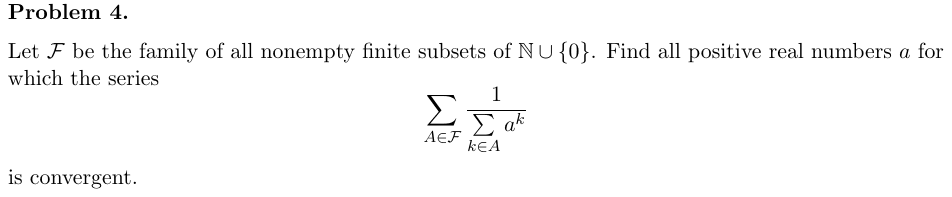
Solution: Let a=2. Any positive integer n can be uniquely represented in base 2:
n=2k1+⋯+2ks
(here,
k1,…,ks are distinct positive integers). Hence, there is a well-defined map
φ:N→F, given by
φ(n)={k1,…,ks}.
Clearly
φ(n)=φ(m) leads to
n=m, i.e.
φ is injective. Moreover
φ(k∈A∑2k)=A,
hence
φ is surjective, and finally bijective. Similarly to the last, according to the definition of
φ we observe
k∈φ(n)∑2k=n.
Hence, we can rewrite the series as follows
A∈F∑k∈A∑2k1=n=1∑∞k∈φ(n)∑2k1=n=1∑∞n1
(the series has only positive terms, so we can rearrange; also, we used that
φ is bijective), which is the harmonic series, and hence divergent. Therefore, the series are divergent for all
a⩽2.
Now let a>2. For any n⩾0, let Fn be the subfamily of sets from F whose greatest element is n. Clearly, there are 2n sets in Fn. Observe that for every A∈Fn holds k∈A∑ak⩾an. Thus
A∈Fn∑k∈A∑ak1⩽A∈Fn∑an1⩽an2n.
Thus, for the initial series we obtain
A∈F∑k∈A∑ak1=n=0∑∞A∈Fn∑k∈A∑ak1⩽n=0∑∞(a2)n.
Since
a>2, the series is dominated by a convergent geometric series, hence it is convergent.
Transcribed from the official solutions, page 4. This transcription has not been checked a second time; if in doubt, look at the original.