IMC 1996, Ημέρα 2, Θέμα 3
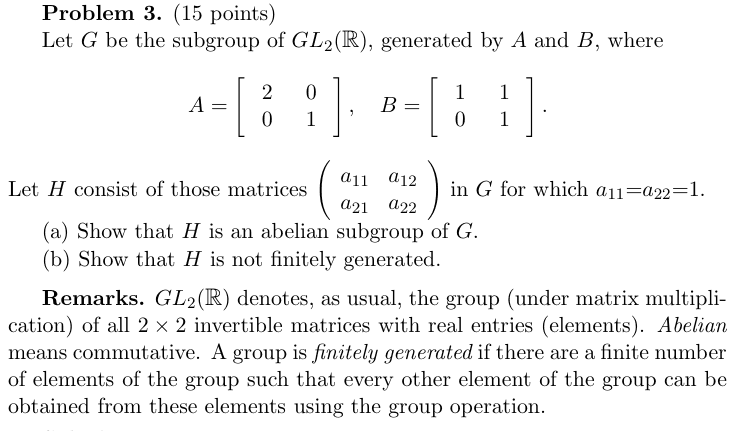
Let be the subgroup of , generated by and , where
Let consist of those matrices in for which .
(a) Show that is an abelian subgroup of .
(b) Show that is not finitely generated.
Remarks. denotes, as usual, the group (under matrix multiplication) of all invertible matrices with real entries (elements). Abelian means commutative. A group is finitely generated if there are a finite number of elements of the group such that every other element of the group can be obtained from these elements using the group operation.
Πρωτότυπο από το επίσημο PDF
Η μεταγραφή συγκρίθηκε σύμβολο προς σύμβολο με το πρωτότυπο, όχι ακόμα από άνθρωπο.
Δούλεψε τουλάχιστον 45 λεπτά πριν ανοίξεις τη λύση.
Επίσημη λύση
Solution.
(a) All of the matrices in are of the form
So all of the matrices in are of the form
so they commute. Since , is a subgroup of .
(b) A generator of can only be of the form , where is a binary rational, i.e., with integer and non-negative integer . In it holds
The matrices of the form are in for all . With only finite number of generators all of them cannot be achieved.
Μεταγραφή από το επίσημο κείμενο λύσεων, σελίδες 11–12. Η μεταγραφή δεν έχει ελεγχθεί δεύτερη φορά· αν έχεις αμφιβολία, κοίτα το πρωτότυπο.
Θέμα αρχείου: η εκφώνηση είναι το επίσημο κείμενο (μεταγραμμένο, με το πρωτότυπο παραπάνω). Η ταξινόμηση ανά αντικείμενο και η δυσκολία εκτιμήθηκαν αυτόματα· υποδείξεις και λύση στα ελληνικά προστίθενται σταδιακά.
Πώς πήγε;
Οι κινήσεις που σημειώνεις επιστρέφουν νωρίτερα στη διαλογή.