uniolympiads English

IMC 1996, Ημέρα 2, Θέμα 4

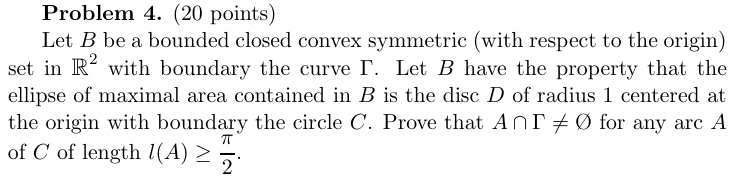
Let BB be a bounded closed convex symmetric (with respect to the origin) set in R2\mathbb{R}^2 with boundary the curve Γ\Gamma. Let BB have the property that the ellipse of maximal area contained in BB is the disc DD of radius 11 centered at the origin with boundary the circle CC. Prove that A∩Γ≠∅A \cap \Gamma \ne \emptyset for any arc AA of CC of length l(A)≥π2l(A) \ge \frac{\pi}{2}.

Πρωτότυπο από το επίσημο PDF(20 points) Let B be a bounded closed convex symmetric (with respect to the origin) set in R 2 with boundary the curve Γ. Let B have the property that the ellipse of maximal area contained in B is the disc D of radius 1 centered at the origin with boundary the circle C. Prove that A ∩ Γ 6 = Ø for any arc A π of C of length l(A) ≥ . 2

Η μεταγραφή συγκρίθηκε σύμβολο προς σύμβολο με το πρωτότυπο, όχι ακόμα από άνθρωπο.

Χρόνος σε αυτό το θέμα 0:00

Δούλεψε τουλάχιστον 45 λεπτά πριν ανοίξεις τη λύση.

Επίσημη λύση

Solution. Assume the contrary – there is an arc A⊂CA \subset C with length l(A)=π2l(A) = \dfrac{\pi}{2} such that A⊂B\ΓA \subset B \backslash \Gamma. Without loss of generality we may assume that the ends of AA are M=(1/2,1/2)M = (1/\sqrt{2}, 1/\sqrt{2}), N=(1/2,−1/2)N = (1/\sqrt{2}, -1/\sqrt{2}). AA is compact and Γ\Gamma is closed. From A∩Γ=ØA \cap \Gamma = \text{Ø} we get δ>0\delta > 0 such that dist⁡(x,y)>δ\operatorname{dist}(x, y) > \delta for every x∈Ax \in A, y∈Γy \in \Gamma.

Given ε>0\varepsilon > 0 with EεE_\varepsilon we denote the ellipse with boundary: x2(1+ε)2+y2b2=1\dfrac{x^2}{(1+\varepsilon)^2} + \dfrac{y^2}{b^2} = 1, such that M,N∈EεM, N \in E_\varepsilon. Since M∈EεM \in E_\varepsilon we get

b2=(1+ε)22(1+ε)2−1.b^2 = \frac{(1+\varepsilon)^2}{2(1+\varepsilon)^2 - 1}.

Then we have

area⁡Eε=π(1+ε)22(1+ε)2−1>π=area⁡D.\operatorname{area} E_\varepsilon = \pi \frac{(1+\varepsilon)^2}{\sqrt{2(1+\varepsilon)^2 - 1}} > \pi = \operatorname{area} D.

In view of the hypotheses, Eε∖B≠ØE_\varepsilon \setminus B \neq \text{Ø} for every ε>0\varepsilon > 0. Let S={(x,y)∈R2:∣x∣>∣y∣}S = \{(x, y) \in \mathbb{R}^2 : |x| > |y|\}. ¿From Eε∖S⊂D⊂BE_\varepsilon \setminus S \subset D \subset B it follows that Eε∖B⊂SE_\varepsilon \setminus B \subset S. Taking ε<δ\varepsilon < \delta we get that

Ø≠Eε∖B⊂Eε∩S⊂D1+ε∩S⊂B\text{Ø} \neq E_\varepsilon \setminus B \subset E_\varepsilon \cap S \subset D_{1+\varepsilon} \cap S \subset B

– a contradiction (we use the notation Dt={(x,y)∈R2:x2+y2≤t2}D_t = \{(x, y) \in \mathbb{R}^2 : x^2 + y^2 \leq t^2\}).

Remark. The ellipse with maximal area is well known as John’s ellipse. Any coincidence with the President of the Jury is accidental.

Μεταγραφή από το επίσημο κείμενο λύσεων, σελίδα 12. Η μεταγραφή δεν έχει ελεγχθεί δεύτερη φορά· αν έχεις αμφιβολία, κοίτα το πρωτότυπο.

Θέμα αρχείου: η εκφώνηση είναι το επίσημο κείμενο (μεταγραμμένο, με το πρωτότυπο παραπάνω). Η ταξινόμηση ανά αντικείμενο και η δυσκολία εκτιμήθηκαν αυτόματα· υποδείξεις και λύση στα ελληνικά προστίθενται σταδιακά.

Πώς πήγε;