IMC 1996, Day 2, Problem 3
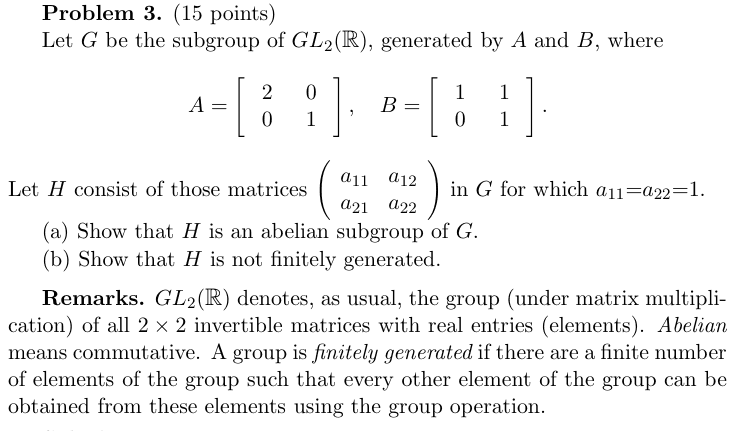
Let be the subgroup of , generated by and , where
Let consist of those matrices in for which .
(a) Show that is an abelian subgroup of .
(b) Show that is not finitely generated.
Remarks. denotes, as usual, the group (under matrix multiplication) of all invertible matrices with real entries (elements). Abelian means commutative. A group is finitely generated if there are a finite number of elements of the group such that every other element of the group can be obtained from these elements using the group operation.
Original from the official PDF
This transcription was compared symbol by symbol with the original, but not yet by a person.
Work for at least 45 minutes before opening the solution.
Official solution
Solution.
(a) All of the matrices in are of the form
So all of the matrices in are of the form
so they commute. Since , is a subgroup of .
(b) A generator of can only be of the form , where is a binary rational, i.e., with integer and non-negative integer . In it holds
The matrices of the form are in for all . With only finite number of generators all of them cannot be achieved.
Transcribed from the official solutions, pages 11–12. This transcription has not been checked a second time; if in doubt, look at the original.
Archive problem: the statement is the official text (transcribed, with the original above). Subject classification and difficulty were estimated automatically; hints and a worked solution are added over time.
How did it go?
Moves you mark come back sooner in triage.