uniolympiads English

IMC 2010, Ημέρα 1, Θέμα 5

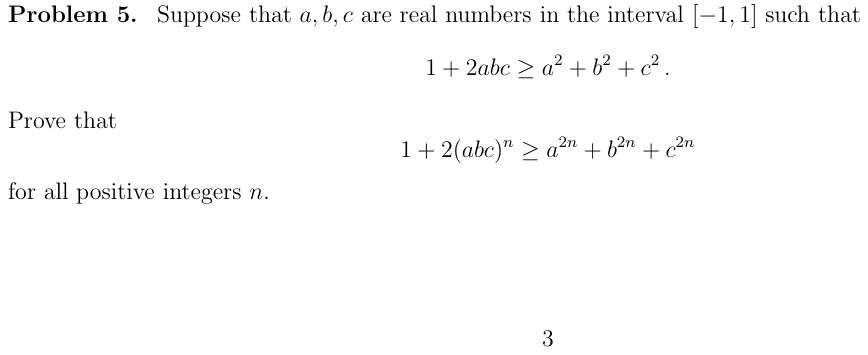
Suppose that a,b,ca, b, c are real numbers in the interval [−1,1][-1, 1] such that

1+2abc≥a2+b2+c2.1 + 2abc \ge a^2 + b^2 + c^2.

Prove that

1+2(abc)n≥a2n+b2n+c2n1 + 2(abc)^n \ge a^{2n} + b^{2n} + c^{2n}

for all positive integers nn.

Πρωτότυπο από το επίσημο PDFSuppose that a, b, c are real numbers in the interval [−1, 1] such that 1 + 2abc ≥ a 2 + b 2 + c 2 . Prove that 1 + 2(abc) n ≥ a 2n + b 2n + c 2n for all positive integers n. 3

Η μεταγραφή συγκρίθηκε σύμβολο προς σύμβολο με το πρωτότυπο, όχι ακόμα από άνθρωπο.

Χρόνος σε αυτό το θέμα 0:00

Δούλεψε τουλάχιστον 45 λεπτά πριν ανοίξεις τη λύση.

Επίσημη λύση

Solution 1. Consider the symmetric matrix

A=(1aba1cbc1).A=\begin{pmatrix}1&a&b\\a&1&c\\b&c&1\end{pmatrix}.
By the constraint we have det⁡A≥0\det A\ge0 and det⁡(1aa1),det⁡(1bb1),det⁡(1cc1)≥0\det\begin{pmatrix}1&a\\a&1\end{pmatrix}, \det\begin{pmatrix}1&b\\b&1\end{pmatrix}, \det\begin{pmatrix}1&c\\c&1\end{pmatrix}\ge0. Hence AA is positive semidefinite, and A=B2A=B^2 for some symmetric real matrix BB.

Let the rows of BB be xx, yy, zz. Then ∣x∣=∣y∣=∣z∣=1|x|=|y|=|z|=1, a=x⋅ya=x\cdot y, b=y⋅zb=y\cdot z and c=z⋅xc=z\cdot x, where ∣x∣|x| and x⋅yx\cdot y denote the Euclidean norm and scalar product. Denote by X=⊗nxX=\otimes^n x, Y=⊗nyY=\otimes^n y, Z=⊗nzZ=\otimes^n z the nnth tensor powers, which belong to R3n\mathbb{R}^{3^n}. Then ∣X∣=∣Y∣=∣Z∣=1|X|=|Y|=|Z|=1, X⋅Y=anX\cdot Y=a^n, Y⋅Z=bnY\cdot Z=b^n and Z⋅X=cnZ\cdot X=c^n. So, the matrix (1anbnan1cnbncn1)\begin{pmatrix}1&a^n&b^n\\a^n&1&c^n\\b^n&c^n&1\end{pmatrix}, being the Gram matrix of three vectors in R3n\mathbb{R}^{3^n}, is positive semidefinite, and its determinant, 1+2(abc)n−a2n−b2n−c2n1+2(abc)^n-a^{2n}-b^{2n}-c^{2n} is non-negative.

Solution 2. The constraint can be written as

(a−bc)2≤(1−b2)(1−c2).(1)(a-bc)^2\le(1-b^2)(1-c^2). \tag{1}
By the Cauchy-Schwarz inequality,
(an−1+an−2bc+…+bn−1cn−1)2≤(∣a∣n−1+∣a∣n−2∣bc∣+…+∣bc∣n−1)2≤≤(1+∣bc∣+…+∣bc∣n−1)2≤(1+∣b∣2+…+∣b∣2(n−1))(1+∣c∣2+…+∣c∣2(n−1))\begin{aligned} &\left(a^{n-1}+a^{n-2}bc+\ldots+b^{n-1}c^{n-1}\right)^2\le\left(|a|^{n-1}+|a|^{n-2}|bc|+\ldots+|bc|^{n-1}\right)^2\le\\ &\le\left(1+|bc|+\ldots+|bc|^{n-1}\right)^2\le\left(1+|b|^2+\ldots+|b|^{2(n-1)}\right)\left(1+|c|^2+\ldots+|c|^{2(n-1)}\right) \end{aligned}
Multiplying by (1), we get
(a−bc)2(an−1+an−2bc+…+bn−1cn−1)2≤((1−b2)(1+∣b∣2+…+∣b∣2(n−1)))((1−c2)(1+∣c∣2+…+∣c∣2(n−1))),(an−bncn)2≤(1−bn)(1−cn),1+2(abc)n≥a2n+b2n+b2n.\begin{gathered} (a-bc)^2(a^{n-1}+a^{n-2}bc+\ldots+b^{n-1}c^{n-1})^2\le\\ \Big((1-b^2)\big(1+|b|^2+\ldots+|b|^{2(n-1)}\big)\Big)\Big((1-c^2)\big(1+|c|^2+\ldots+|c|^{2(n-1)}\big)\Big),\\ (a^n-b^nc^n)^2\le(1-b^n)(1-c^n),\\ 1+2(abc)^n\ge a^{2n}+b^{2n}+b^{2n}. \end{gathered}

Μεταγραφή από το επίσημο κείμενο λύσεων, σελίδα 4. Η μεταγραφή δεν έχει ελεγχθεί δεύτερη φορά· αν έχεις αμφιβολία, κοίτα το πρωτότυπο.

Θέμα αρχείου: η εκφώνηση είναι το επίσημο κείμενο (μεταγραμμένο, με το πρωτότυπο παραπάνω). Η ταξινόμηση ανά αντικείμενο και η δυσκολία εκτιμήθηκαν αυτόματα· υποδείξεις και λύση στα ελληνικά προστίθενται σταδιακά.

Πώς πήγε;