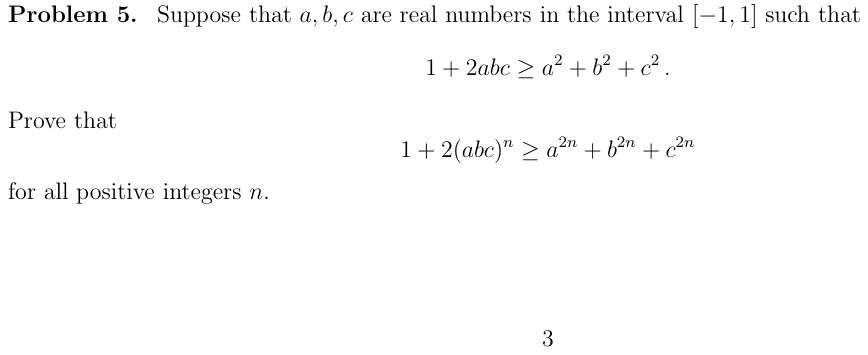
Suppose that a,b,c are real numbers in the interval [−1,1] such that
1+2abc≥a2+b2+c2.
Prove that
1+2(abc)n≥a2n+b2n+c2n
for all positive integers n.
Original from the official PDF
This transcription was compared symbol by symbol with the original, but not yet by a person.
Time on this problem
Work for at least 45 minutes before opening the solution.
Official solution
Solution 1. Consider the symmetric matrix
A=1aba1cbc1.
By the constraint we have detA≥0 and det(1aa1),det(1bb1),det(1cc1)≥0. Hence A is positive semidefinite, and A=B2 for some symmetric real matrix B.
Let the rows of B be x, y, z. Then ∣x∣=∣y∣=∣z∣=1, a=x⋅y, b=y⋅z and c=z⋅x, where ∣x∣ and x⋅y denote the Euclidean norm and scalar product. Denote by X=⊗nx, Y=⊗ny, Z=⊗nz the nth tensor powers, which belong to R3n. Then ∣X∣=∣Y∣=∣Z∣=1, X⋅Y=an, Y⋅Z=bn and Z⋅X=cn. So, the matrix 1anbnan1cnbncn1, being the Gram matrix of three vectors in R3n, is positive semidefinite, and its determinant, 1+2(abc)n−a2n−b2n−c2n is non-negative.
Transcribed from the official solutions, page 4. This transcription has not been checked a second time; if in doubt, look at the original.
Archive problem: the statement is the official text (transcribed, with the original above). Subject classification and difficulty were estimated automatically; hints and a worked solution are added over time.