IMC 2010, Ημέρα 2, Θέμα 1
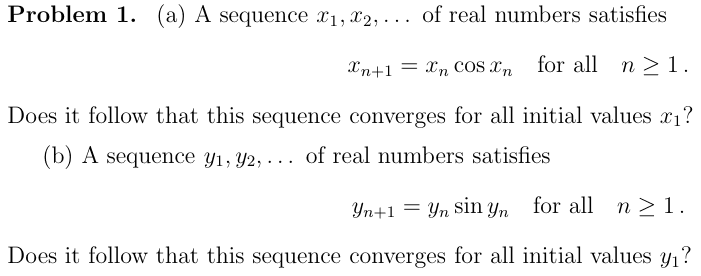
(a) A sequence of real numbers satisfies
Does it follow that this sequence converges for all initial values ?
(b) A sequence of real numbers satisfies
Does it follow that this sequence converges for all initial values ?
Πρωτότυπο από το επίσημο PDF
Η μεταγραφή συγκρίθηκε σύμβολο προς σύμβολο με το πρωτότυπο, όχι ακόμα από άνθρωπο.
Δούλεψε τουλάχιστον 45 λεπτά πριν ανοίξεις τη λύση.
Επίσημη λύση
Solution 1. (a) NO. For example, for we have , and the sequence is divergent.
(b) YES. Notice that is nonincreasing and hence converges to some number .
If , then and we are done. If , then , so and for some nonnegative integer .
Since the sequence is nonincreasing, there exists an index such that for all . Then all the numbers lie in the union of the intervals and .
Depending on the parity of , in one of the intervals and the values of the sine function is positive; denote this interval by . In the other interval the sine function is negative; denote this interval by . If for some then and have opposite signs, so . On the other hand, if If for some then and have the same sign, so . In both cases, .
We obtained that the numbers lie in , so they have the same sign. Since is convergent, this implies that the sequence is convergent as well.
Solution 2 for part (b). Similarly to the first solution, for some real number .
Notice that for all real , hence for all . Since the function is continuous, .
Μεταγραφή από το επίσημο κείμενο λύσεων, σελίδα 1. Η μεταγραφή δεν έχει ελεγχθεί δεύτερη φορά· αν έχεις αμφιβολία, κοίτα το πρωτότυπο.
Θέμα αρχείου: η εκφώνηση είναι το επίσημο κείμενο (μεταγραμμένο, με το πρωτότυπο παραπάνω). Η ταξινόμηση ανά αντικείμενο και η δυσκολία εκτιμήθηκαν αυτόματα· υποδείξεις και λύση στα ελληνικά προστίθενται σταδιακά.
Πώς πήγε;
Οι κινήσεις που σημειώνεις επιστρέφουν νωρίτερα στη διαλογή.