IMC 2010, Day 2, Problem 1
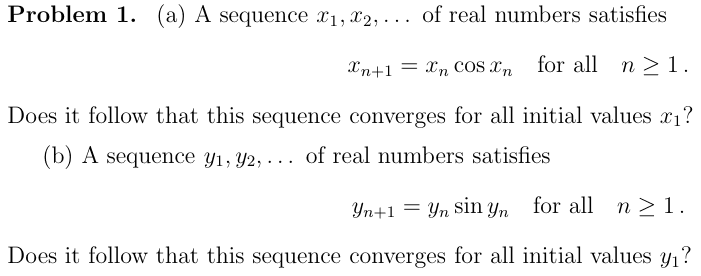
(a) A sequence of real numbers satisfies
Does it follow that this sequence converges for all initial values ?
(b) A sequence of real numbers satisfies
Does it follow that this sequence converges for all initial values ?
Original from the official PDF
This transcription was compared symbol by symbol with the original, but not yet by a person.
Work for at least 45 minutes before opening the solution.
Official solution
Solution 1. (a) NO. For example, for we have , and the sequence is divergent.
(b) YES. Notice that is nonincreasing and hence converges to some number .
If , then and we are done. If , then , so and for some nonnegative integer .
Since the sequence is nonincreasing, there exists an index such that for all . Then all the numbers lie in the union of the intervals and .
Depending on the parity of , in one of the intervals and the values of the sine function is positive; denote this interval by . In the other interval the sine function is negative; denote this interval by . If for some then and have opposite signs, so . On the other hand, if If for some then and have the same sign, so . In both cases, .
We obtained that the numbers lie in , so they have the same sign. Since is convergent, this implies that the sequence is convergent as well.
Solution 2 for part (b). Similarly to the first solution, for some real number .
Notice that for all real , hence for all . Since the function is continuous, .
Transcribed from the official solutions, page 1. This transcription has not been checked a second time; if in doubt, look at the original.
Archive problem: the statement is the official text (transcribed, with the original above). Subject classification and difficulty were estimated automatically; hints and a worked solution are added over time.
How did it go?
Moves you mark come back sooner in triage.