IMC 2025, Ημέρα 1, Θέμα 1
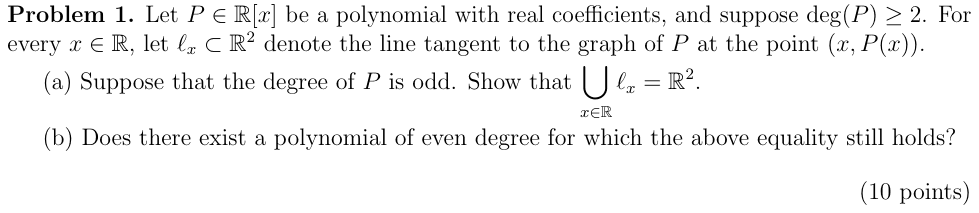
Let be a polynomial with real coefficients, and suppose . For every , let denote the line tangent to the graph of at the point .
(a) Suppose that the degree of is odd. Show that .
(b) Does there exist a polynomial of even degree for which the above equality still holds?
Πρωτότυπο από το επίσημο PDF
Η μεταγραφή συγκρίθηκε σύμβολο προς σύμβολο με το πρωτότυπο, όχι ακόμα από άνθρωπο.
Δούλεψε τουλάχιστον 45 λεπτά πριν ανοίξεις τη λύση.
Επίσημη λύση
(proposed by Mike Daas, Max Planck Institute for Mathematics, Bonn)
Solution.
(a) Suppose that the degree of is odd and let be arbitrary. Given , the equation for is given by
This is a polynomial equation in , which always has a real solution as soon as we can show that the degree is odd. Indeed, if describes the leading term, then the right hand side of the above equation has leading term . Since and we assumed that , we must have . The right hand side therefore has the same degree as , completing the proof.
(b) If the degree of is even, then this can never be true, because the degree of is now even by the same argument and therefore it has a global minimum (or maximum) over the reals, below (or above) which no value of will yield a real solution for .
Μεταγραφή από το επίσημο κείμενο λύσεων, σελίδες 1–2. Η μεταγραφή δεν έχει ελεγχθεί δεύτερη φορά· αν έχεις αμφιβολία, κοίτα το πρωτότυπο.
Θέμα αρχείου: η εκφώνηση είναι το επίσημο κείμενο (μεταγραμμένο, με το πρωτότυπο παραπάνω). Η ταξινόμηση ανά αντικείμενο και η δυσκολία εκτιμήθηκαν αυτόματα· υποδείξεις και λύση στα ελληνικά προστίθενται σταδιακά.
Πώς πήγε;
Οι κινήσεις που σημειώνεις επιστρέφουν νωρίτερα στη διαλογή.