IMC 2025, Day 1, Problem 1
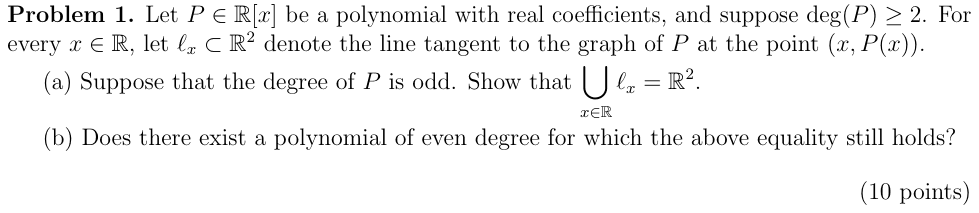
Let be a polynomial with real coefficients, and suppose . For every , let denote the line tangent to the graph of at the point .
(a) Suppose that the degree of is odd. Show that .
(b) Does there exist a polynomial of even degree for which the above equality still holds?
Original from the official PDF
This transcription was compared symbol by symbol with the original, but not yet by a person.
Work for at least 45 minutes before opening the solution.
Official solution
(proposed by Mike Daas, Max Planck Institute for Mathematics, Bonn)
Solution.
(a) Suppose that the degree of is odd and let be arbitrary. Given , the equation for is given by
This is a polynomial equation in , which always has a real solution as soon as we can show that the degree is odd. Indeed, if describes the leading term, then the right hand side of the above equation has leading term . Since and we assumed that , we must have . The right hand side therefore has the same degree as , completing the proof.
(b) If the degree of is even, then this can never be true, because the degree of is now even by the same argument and therefore it has a global minimum (or maximum) over the reals, below (or above) which no value of will yield a real solution for .
Transcribed from the official solutions, pages 1–2. This transcription has not been checked a second time; if in doubt, look at the original.
Archive problem: the statement is the official text (transcribed, with the original above). Subject classification and difficulty were estimated automatically; hints and a worked solution are added over time.
How did it go?
Moves you mark come back sooner in triage.