uniolympiads English

IMC 2025, Ημέρα 1, Θέμα 2

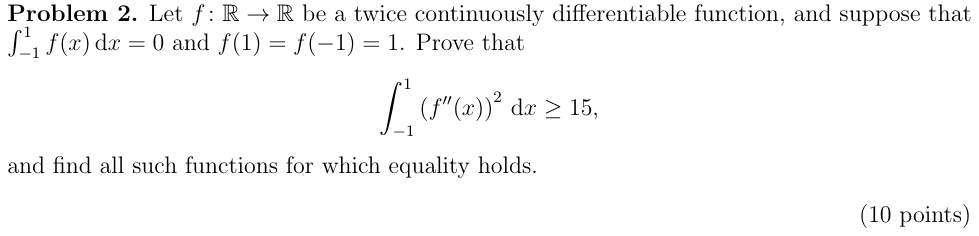
Let f ⁣:R→Rf\colon \mathbb{R} \to \mathbb{R} be a twice continuously differentiable function, and suppose that ∫−11f(x) dx=0\int_{-1}^{1} f(x)\,dx = 0 and f(1)=f(−1)=1f(1) = f(-1) = 1. Prove that

∫−11(f′′(x))2 dx≥15,\int_{-1}^{1} \big(f''(x)\big)^2\,dx \ge 15,

and find all such functions for which equality holds.

Πρωτότυπο από το επίσημο PDFLet f : R → R be a twice continuously differentiable function, and suppose that R 1 f (x) dx = 0 and f (1) = f (−1) = 1. Prove that −1 Z 1 2 (f ′′ (x)) dx ≥ 15, −1 and find all such functions for which equality holds.

Η μεταγραφή συγκρίθηκε σύμβολο προς σύμβολο με το πρωτότυπο, όχι ακόμα από άνθρωπο.

Χρόνος σε αυτό το θέμα 0:00

Δούλεψε τουλάχιστον 45 λεπτά πριν ανοίξεις τη λύση.

Επίσημη λύση

(proposed by Alberto Cagnetta, Università degli Studi di Udine, Italy)

Solution. If gg is an arbitrary twice continously differentable function on [−1,1][-1,1], then by applying the Caucy–Schwarz inequality for f′′f'' and gg and integrate by parts twice we get

∫−11(f′′)2⋅∫−11g2≥∫−11f′′g=(f′(1)g(1)−f′(−1)g(−1))−∫−11f′g′==(f′(1)g(1)−f′(−1)g(−1))−(f(1)g′(1)−f(−1)g′(−1))+∫−11fg′′=(f′(1)g(1)−f′(−1)g(−1)−g′(1)+g′(−1))+∫−11fg′′.(1)\begin{aligned} \sqrt{\int_{-1}^{1}(f'')^2\cdot\int_{-1}^{1}g^2} \ge \int_{-1}^{1}f''g &= \big(f'(1)g(1) - f'(-1)g(-1)\big) - \int_{-1}^{1}f'g' = \\ &= \big(f'(1)g(1) - f'(-1)g(-1)\big) - \big(f(1)g'(1) - f(-1)g'(-1)\big) + \int_{-1}^{1}fg'' \\ &= \big(f'(1)g(1) - f'(-1)g(-1) - g'(1) + g'(-1)\big) + \int_{-1}^{1}fg''. \qquad (1) \end{aligned}

In order to get rid of the terms f′(1)g(1)f'(1)g(1) and f′(−1)g(−1)f'(-1)g(-1) we will chose gg such that g(1)=g(−1)=0g(1) = g(-1) = 0. Moreover, if g′′g'' is constant, so gg is an at most quadratic polynomial, then ∫−11fg′′=g′′∫−11=f0\int_{-1}^{1}fg'' = g''\int_{-1}^{1} = f0. Hence, it is reasonable to apply (1) with g(x)=(1+x)(1−x)=1−x2g(x) = (1+x)(1-x) = 1 - x^2.

With this choice,

g(1)=g(−1)=0,g′(1)=−2,g′(−1)=2,g′′≡−2g(1) = g(-1) = 0, \quad g'(1) = -2, \quad g'(-1) = 2, \quad g'' \equiv -2
and
∫−11g2=∫−11(1−2x2+x4) dx=1615,\int_{-1}^{1}g^2 = \int_{-1}^{1}(1 - 2x^2 + x^4)\,\mathrm{d}x = \frac{16}{15},
so we get
∫−11(f′′)2⋅1615≥0−0−g′(1)+g′(−1)+0=4,\sqrt{\int_{-1}^{1}(f'')^2\cdot\frac{16}{15}} \ge 0 - 0 - g'(1) + g'(-1) + 0 = 4,
∫−11(f′′)2≥15.\int_{-1}^{1}(f'')^2 \ge 15.

Equality in Cauchy–Schwarz in (1) holds only if there exists a real λ\lambda such that f′′(x)=λg(x)f''(x) = \lambda g(x) almost everywhere in [−1,1][-1,1]; by continuity of f′′f'' and gg we have f′′=λgf'' = \lambda g everwhere on the interval [−1,1][-1,1]. Hence f(x)f(x) must have the form

f(x)=λ(x22−x412)+ax+b,with λ,a,b∈R.f(x) = \lambda\left(\frac{x^2}{2} - \frac{x^4}{12}\right) + ax + b, \quad \text{with } \lambda, a, b \in \mathbb{R}.

From ∫−11f(x)dx=0\int_{-1}^{1}f(x)\mathrm{d}x = 0, we get 0=3λ10+2b0 = \frac{3\lambda}{10} + 2b, hence b=−320λb = -\frac{3}{20}\lambda. Moreover, the condition f(1)=f(−1)=1f(1) = f(-1) = 1 implies

λ(12−112)+a−320λ=f(1)=1=f(−1)=λ(12−112)−a−320λ\lambda\left(\frac{1}{2} - \frac{1}{12}\right) + a - \frac{3}{20}\lambda = f(1) = 1 = f(-1) = \lambda\left(\frac{1}{2} - \frac{1}{12}\right) - a - \frac{3}{20}\lambda
hence a=0a = 0, and λ=154\lambda = \frac{15}{4}.

In conclusion, the equality holds if and only if

f(x)=154⋅(x22−x412−320)=−5x4+30x2−916for all x∈[−1,1].f(x) = \frac{15}{4}\cdot\left(\frac{x^2}{2} - \frac{x^4}{12} - \frac{3}{20}\right) = \frac{-5x^4 + 30x^2 - 9}{16} \quad \text{for all } x \in [-1,1].

Μεταγραφή από το επίσημο κείμενο λύσεων, σελίδες 2–3. Η μεταγραφή δεν έχει ελεγχθεί δεύτερη φορά· αν έχεις αμφιβολία, κοίτα το πρωτότυπο.

Θέμα αρχείου: η εκφώνηση είναι το επίσημο κείμενο (μεταγραμμένο, με το πρωτότυπο παραπάνω). Η ταξινόμηση ανά αντικείμενο και η δυσκολία εκτιμήθηκαν αυτόματα· υποδείξεις και λύση στα ελληνικά προστίθενται σταδιακά.

Πώς πήγε;