uniolympiads Ελληνικά

IMC 2025, Day 1, Problem 2

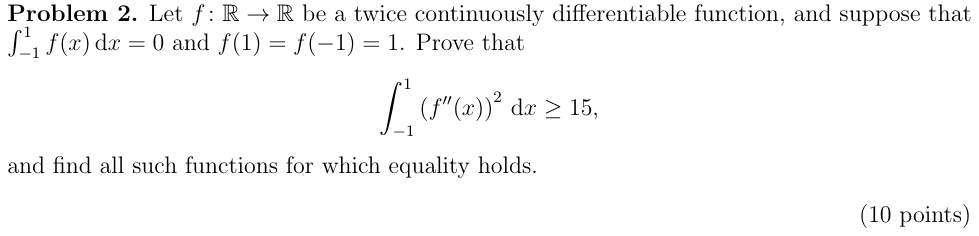
Let f ⁣:R→Rf\colon \mathbb{R} \to \mathbb{R} be a twice continuously differentiable function, and suppose that ∫−11f(x) dx=0\int_{-1}^{1} f(x)\,dx = 0 and f(1)=f(−1)=1f(1) = f(-1) = 1. Prove that

∫−11(f′′(x))2 dx≥15,\int_{-1}^{1} \big(f''(x)\big)^2\,dx \ge 15,

and find all such functions for which equality holds.

Original from the official PDFLet f : R → R be a twice continuously differentiable function, and suppose that R 1 f (x) dx = 0 and f (1) = f (−1) = 1. Prove that −1 Z 1 2 (f ′′ (x)) dx ≥ 15, −1 and find all such functions for which equality holds.

This transcription was compared symbol by symbol with the original, but not yet by a person.

Time on this problem 0:00

Work for at least 45 minutes before opening the solution.

Official solution

(proposed by Alberto Cagnetta, Università degli Studi di Udine, Italy)

Solution. If gg is an arbitrary twice continously differentable function on [−1,1][-1,1], then by applying the Caucy–Schwarz inequality for f′′f'' and gg and integrate by parts twice we get

∫−11(f′′)2⋅∫−11g2≥∫−11f′′g=(f′(1)g(1)−f′(−1)g(−1))−∫−11f′g′==(f′(1)g(1)−f′(−1)g(−1))−(f(1)g′(1)−f(−1)g′(−1))+∫−11fg′′=(f′(1)g(1)−f′(−1)g(−1)−g′(1)+g′(−1))+∫−11fg′′.(1)\begin{aligned} \sqrt{\int_{-1}^{1}(f'')^2\cdot\int_{-1}^{1}g^2} \ge \int_{-1}^{1}f''g &= \big(f'(1)g(1) - f'(-1)g(-1)\big) - \int_{-1}^{1}f'g' = \\ &= \big(f'(1)g(1) - f'(-1)g(-1)\big) - \big(f(1)g'(1) - f(-1)g'(-1)\big) + \int_{-1}^{1}fg'' \\ &= \big(f'(1)g(1) - f'(-1)g(-1) - g'(1) + g'(-1)\big) + \int_{-1}^{1}fg''. \qquad (1) \end{aligned}

In order to get rid of the terms f′(1)g(1)f'(1)g(1) and f′(−1)g(−1)f'(-1)g(-1) we will chose gg such that g(1)=g(−1)=0g(1) = g(-1) = 0. Moreover, if g′′g'' is constant, so gg is an at most quadratic polynomial, then ∫−11fg′′=g′′∫−11=f0\int_{-1}^{1}fg'' = g''\int_{-1}^{1} = f0. Hence, it is reasonable to apply (1) with g(x)=(1+x)(1−x)=1−x2g(x) = (1+x)(1-x) = 1 - x^2.

With this choice,

g(1)=g(−1)=0,g′(1)=−2,g′(−1)=2,g′′≡−2g(1) = g(-1) = 0, \quad g'(1) = -2, \quad g'(-1) = 2, \quad g'' \equiv -2
and
∫−11g2=∫−11(1−2x2+x4) dx=1615,\int_{-1}^{1}g^2 = \int_{-1}^{1}(1 - 2x^2 + x^4)\,\mathrm{d}x = \frac{16}{15},
so we get
∫−11(f′′)2⋅1615≥0−0−g′(1)+g′(−1)+0=4,\sqrt{\int_{-1}^{1}(f'')^2\cdot\frac{16}{15}} \ge 0 - 0 - g'(1) + g'(-1) + 0 = 4,
∫−11(f′′)2≥15.\int_{-1}^{1}(f'')^2 \ge 15.

Equality in Cauchy–Schwarz in (1) holds only if there exists a real λ\lambda such that f′′(x)=λg(x)f''(x) = \lambda g(x) almost everywhere in [−1,1][-1,1]; by continuity of f′′f'' and gg we have f′′=λgf'' = \lambda g everwhere on the interval [−1,1][-1,1]. Hence f(x)f(x) must have the form

f(x)=λ(x22−x412)+ax+b,with λ,a,b∈R.f(x) = \lambda\left(\frac{x^2}{2} - \frac{x^4}{12}\right) + ax + b, \quad \text{with } \lambda, a, b \in \mathbb{R}.

From ∫−11f(x)dx=0\int_{-1}^{1}f(x)\mathrm{d}x = 0, we get 0=3λ10+2b0 = \frac{3\lambda}{10} + 2b, hence b=−320λb = -\frac{3}{20}\lambda. Moreover, the condition f(1)=f(−1)=1f(1) = f(-1) = 1 implies

λ(12−112)+a−320λ=f(1)=1=f(−1)=λ(12−112)−a−320λ\lambda\left(\frac{1}{2} - \frac{1}{12}\right) + a - \frac{3}{20}\lambda = f(1) = 1 = f(-1) = \lambda\left(\frac{1}{2} - \frac{1}{12}\right) - a - \frac{3}{20}\lambda
hence a=0a = 0, and λ=154\lambda = \frac{15}{4}.

In conclusion, the equality holds if and only if

f(x)=154⋅(x22−x412−320)=−5x4+30x2−916for all x∈[−1,1].f(x) = \frac{15}{4}\cdot\left(\frac{x^2}{2} - \frac{x^4}{12} - \frac{3}{20}\right) = \frac{-5x^4 + 30x^2 - 9}{16} \quad \text{for all } x \in [-1,1].

Transcribed from the official solutions, pages 2–3. This transcription has not been checked a second time; if in doubt, look at the original.

Archive problem: the statement is the official text (transcribed, with the original above). Subject classification and difficulty were estimated automatically; hints and a worked solution are added over time.
How did it go?